
Worldbuilding Guide: Airships - The airship in fiction
What do airships mean in a novel?

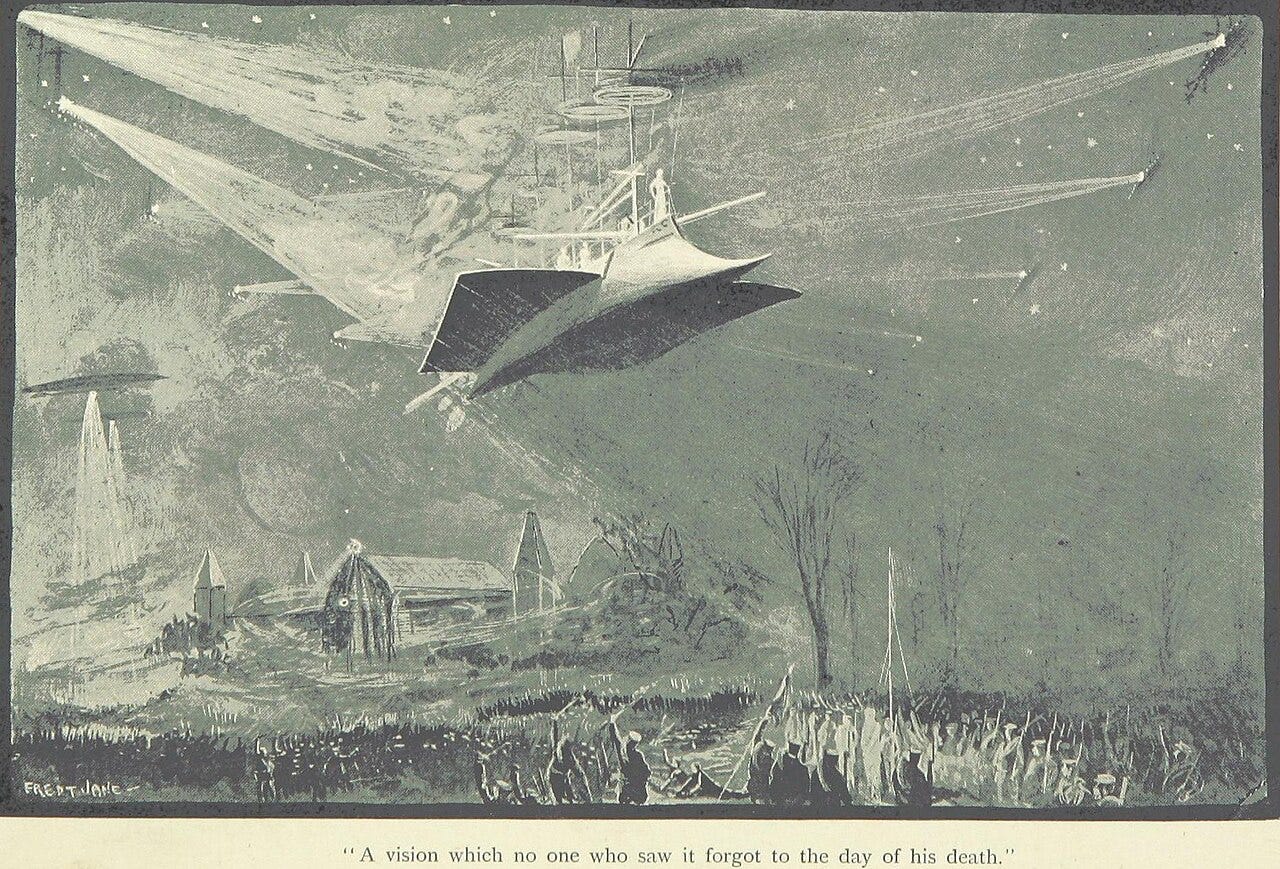
This is the second part of a four-part post on airships in fictional settings. Read the first here. Here’s what we’re covering, focusing on 2 this week:
How airships have been used in fiction, with a focus on the fantasy genre.
The design of a fictional airship in detail and how we can modify her world to suit.
How a society and economy dependent on airships works around the ships themselves.
Airships in fiction
As we saw last week, real airships in the early twentieth century were dubious from a practical perspective. But they loomed much larger on the page, serving as a symbol for whole movements and eras. For a few decades, from around 1880 to 1910, they held the world transfixed: symbols of the enormous power placed into the hands of Europe’s sovereigns by industry, hands that now seemed ready to cast civilization itself into the flames.
To understand that, however, we need to start earlier: with the first fictional aeronauts, who sprang onto the page almost as soon as their real counterparts had made their first ascents. These ascents were spectacles in their day that stoked intense public interest, so this is no surprise, but it helped that balloons had a cultural niche pre-prepared for them. Consider the earliest ancestors of science fiction: Lucian’s True History, The Man in the Moone, Cyrano de Bergerac’s moon stories, and even Gulliver’s Travels with its floating islands. The sky (this was before the atmosphere and deep space were thought of as two distinct places) was somewhere fantastical the narrative could ascend to, and thereby look down on the patchwork world below, taking it all in at once with a critical eye.
That angle was applied to early balloon fiction. A lot of this was like the eighteenth century version of internet posting - rapid-fire reactions and political glosses of this new phenomenon. But over time, experience with real balloons became established as well. The most important thing here was the randomness of real balloon travel. Older fantastical stories had always taken place on narrative rails, but real balloons could not be controlled and went wherever the wind deigned to send them. There was less of the freedom that flight is associated with today. Instead, the balloon was a sort of randomizer. Get in and see what adventure the world sends you to. Understandably, this created a supply of Boy’s Own-style adventure fiction using this feature as a narrative device.
The tradition of proto-SF tales about voyages to the moon continued, particularly with Edgar Allan Poe’s entry Hans Pfaall. This was pretty similar to the original examples, but incorporated up to date science and aspects of real balloon flight. Poe also helped run the Balloon Hoax around this time, which involved a fake newspaper story about a transatlantic crossing by balloon that generated intense, if brief, public interest.
The Hoax draws out another aspect of early flight that was important in fiction. Flight was unpredictable and so it was seen as powerful long before it was useful. The Montgolfiers had done something thought impossible practically overnight: what was stopping their successors from making similar leaps - a transatlantic crossing, or even conquering the world?
In 1863 Verne capped the balloon adventure genre with Five Weeks in a Balloon. His balloon was much more purposeful. With a series of speculative devices, his characters could steer themselves pretty much where they wished, and used this new power to explore the interior of Africa. Public interest in things like the source of the Nile was at its peak and Verne exploited this masterfully. There were certainly colonial undercurrents: the balloon is not a detached, observational platform as in earlier tales, but something that intervenes in its environment. Verne’s crew defends missionaries and shoots rare wildlife. At the same time, there wasn’t the same dizzying agency as later fictional aeronauts would be afforded. The balloon is constantly saved by coincidences and Verne strongly impresses upon you that this whole voyage only happens through the grace of God.
This picture had changed significantly by the time Verne returned to aviation twenty years later with Robur the Conqueror in 1886. This was a new direction, even though Robur was just a reskinned Captain Nemo and the novel itself was inferior to 20,000 Leagues. Robur is the polar opposite of the early balloon protagonists: he’s built his own go-anywhere flying machine he’s in complete control of. He’s got an agenda and he’s not afraid to upend the empires of the Earth to enact it. There’s no God to be seen.
Nemo and Robur built on a tradition solidified by Frankenstein. They’re every bit the Byronic hero, what we might today call a mad scientist. Verne was writing in an era where it really did seem realistic that a lone genius could design and build a machine that could achieve feats previously thought impossible. As powered flight seemed to come closer to reality in the last years of the nineteenth century, its fictional image became protagonists like Robur. Popular expectation saw the technology as incredibly powerful - even to the extent of reshaping the human condition.
That last point was the genesis of the next phase of fictional airships. In the early years of the twentieth century, as we saw last week, powered flight finally arrived in a real, practical form. In this era airships firmly belonged in science fiction. Consensus was that it was only a matter of time until airship routes bridled the world; the question was, what would that world look like? Most, it seemed, saw authoritarianism on the horizon.
The idea was that control of the air would be a sort of ultimate power. From our perspective it’s easier to think about it if you substitute airships for nuclear weapons: airships would lead to one group dominating the world, but they would also end war by promising unbearable ruin for anyone who dared stand against them. This attitude is on full display in H.G. Wells’ The War in the Air, in which civilization is destroyed by aerial bombing conducted by airships.
We now arrive at Kipling’s With the Night Mail (1905) and As Easy as ABC (1912), which are the pinnacle of this micro-genre. But they’re also remarkable tales in their own right and pivotal, underappreciated examples of early science fiction. Both stories are set in the same universe - the first in the distant 2000 A.D. and the second sixty-five years after that - where airships rule the world. Literally: the ABC, the “Aerial Board of Control”, is a one world government by the time of the second tale, which uses advanced airships as the instrument of its power.
The first thing you notice when reading Night Mail is how modern it feels. If you took me in blind I’d guess it was a steampunk story from the 1980s or 1990s. Imagine someone of Kipling’s stature writing this sort of zany, innovative SF today. It totally breaks with the conventions of the time and has all sorts of modern features. It drops the reader into an unfamiliar future setting and has them figure things out through context clues, it has a lexicon of invented jargon, and it’s even presented as a piece of journalism complete with in-universe advertisements for worldbuilding. At the same time, the Kipling stories are clearly a product of the early twentieth century. London is the undisputed capital of the world even in 2065. Things are different but not that different, which gives the stories their steampunk feel, a quality I find fascinating: Night Mail is authentic retrofuture, compared to the counterculturally manufactured steampunk of decades later. It feels like Kipling has assumed economic growth will continue but as a linear rather than exponential trend. All the trends he saw around him are simply extrapolated forward.
Anyway, where does this whole idea of airships as kingmakers come from? Part of it is the transition to industrialized warfare. As the world slid toward the beginning of the twentieth century it became clearer and clearer that the next major war was going to be different: so different that it would completely upend everything people knew about war. There was a market in sketching this out for an anxious public, a tradition Wells was tapping with The War in the Air, but this had all begun decades earlier with more grounded stories of nations conquering one another overnight.
So the use of the airship here wasn’t so much a technical prediction. Instead airships, the universally recognized symbol of the industrial future, stood in for the whole thing. So when you look at a novel like The Angel of the Revolution or The War in the Air, it seems ludicrous on the surface that airships are able to nearly end civilization and hold all the Great Powers to ransom. But Wells and Griffith’s actual point - that the aristocratic governments of Europe would unleash an apocalypse by misusing the power industry had granted them - was, in retrospect, correct. Wells nailed the feeling of aerial bombing if not the particulars. Griffith’s utopia, where an inventor conjures up a fantastical airship to impose peace on Europe by force, is tragic. It’s nothing less than the plea of a civilization that knew it was condemned.
So in many ways the airship and all it symbolized really was like a nuclear weapon. World War I was a sort of low-grade, low-tech nuclear holocaust, even if real airships barely played a role. It’s interesting to compare this to the reaction to real nuclear weapons decades later and the similar (but this time mistaken) expectation that they would be misused by the nations of the world, dragging the population down to Armageddon.
Another component to the air power narrative is the airship’s association with high modernism and technocracy. As we covered last week, airships had to be carefully managed, and had to be flown by a caste of secretive experts lest some small mistake wreck the entire thing. And there was still that element of seeing the world from thousands of feet up, the patchwork fields laid out not quite in a perfectly rectangular grid, but if we could just tweak the borders a little…
This comes through more in Night Mail and ABC, where the world has sunk into atomized sterility, especially in the latter. Everyone is an atheist who loves rational planning and sees no appeal in democracy, preferring for all conflict to be delegated to a committee of supreme experts. Wells would later head in this direction too with The Shape of Things to Come, though with a positive gloss on his technocracy rather than the negative one they get in ABC. You can understand the appeal of this model in the early decades of the twentieth century where it seemed there was a good chance that industrialization would lead to endless, apocalyptic wars. Something had to be done, some solution had to be found, even if that meant sacrificing democracy and freedom. At the same time the expert was ascendant. These were the years of World’s Fairs, of ticker-tape parades for technical breakthroughs, of Martians taking great strides through the deep vaults of Nature. It was the time of broken-backed farmers watching the power lines approach over the horizon, pole by pole. But though the expert’s technical achievements would endure, their time in the cultural sun would wane.
With it went airships.
The wreck of the Hindenburg just four years after The Shape of Things to Come was published was not a killing blow for airships. Passengers were used to hearing about air crashes, and airships had proved themselves far safer than airplanes, Hindenburg or no Hindenburg. And the crash was attributable to pilot errors that a better captain like Hugo Eckener would have avoided. But it was a cultural event, the first recorded and widely transmitted disaster of its kind. For once the spectacle of airships worked against them, and the airplane stepped in to sweep its larger cousins from history.
When the dust from World War II settled the world had been introduced to a new age and a new technology to symbolise it: the atomic bomb. Science fiction, having abandoned airships, turned to rockets, computers, and all things atomic. The new frontier lay beyond the atmosphere and hence was closed to the airship.
From around 1940 to 1970, airships were on the back foot in Western fiction. They survived in a few niches. There were low-rent rehashes of adventure fiction which used them for their romance (and because they had always been part of the formula). And airships were still a classic symbol of German power, a calling card of Nazis, which seems to have been their main cultural association during the period - another reason for their disappearance in other kinds of fiction. But their most notable niche was in Asia.
Japan was a cultural refuge for airships during the dry years. As it was rebuilt following World War II, airships began to appear in Japanese media as a symbol of a bucolic early-industrial Europe - the same place that people suffering from Paris syndrome think they are about to visit. They were added to a stable of symbols that served as an Eastern version of the katana, oni mask, kimono, and paper screen. Eventually, however, they would move beyond this to produce their own parallel set of tropes, ones that leaned more toward the fantastical. This explains the significantly gentler aspect of airships in the Japanese media of the succeeding decades, such as Kiki’s Delivery Service or Nadia, though Miyazaki’s love of aircraft in general also played a role. Scores of JRPGs in the 1990s and 2000s used them as a pure symbol of freedom and adventure. However, there are still hints of the old power/control tropes in some cases, such as Nausicaa or Castle in the Sky.
But in the West airships were firmly period technology, and it was just this characteristic that would lead to their return.
With enough historical distance, the airship’s Nazi connotations softened and it became a symbol of early twentieth century optimism - not a dead end, but an expression of the future that was cancelled by the World Wars. One of the key prototypes for steampunk as a genre and the revival of airships, The Warlord of the Air, ends with a footnote establishing its narrator’s death in World War I. Airships’ status as the cultural flagship of their era made them a key pillar of this new movement.
Warlord, published in 1971, tells the story of a man from 1903 thrust forward into an alternate 1973 where World War I never happened and the Great Powers have an iron grip on the globe. As in Night Mail, vast fleets of airships straddle the globe and London is the utopian centre of the world. But there’s a new undercurrent: this utopia is maintained by the oppression of the global south, which remains under the imperial thumb of Europe and Japan.
This marks the beginning of steampunk, though the genre would not be named until the 1980s. Warlord was a thoroughly original novel; though it has influences, such as from the last Gormenghast book, its formula of retrofuture and empire was a fresh combination.
So, as steampunk developed over the next few decades with novels like The Anubis Gates, The Digging Leviathan, Homunculus, Infernal Devices, and The Difference Engine, airships took on a new position. Despite the total failure of the actual British airship programs, they became associated with the predominantly British retrofutures of steampunk, taking on not just their old role as a symbol of technological progress but also a darker undertone of imperialist oppression or Victorian prejudice.
During the 1990s, steampunk had solidified into a genre, and tropes had emerged. Works that took it seriously began to take the genre to new places, beginning with Difference Engine in 1990. Perdido Street Station used its period elements as a vehicle for its Marxist politics, and The Diamond Age used genre tropes as a leaping-off point to investigate the Victorian moral universe more deeply than before. Airships and their associations were part of this package even when they weren’t directly present, as in Diamond Age’s Neo-Victorian navy, which inherits many qualities from the Aerial Board of Control’s world-straddling fleets.
During the 2000s steampunk tropes, divorced from their original underpinnings, exploded into mainstream awareness. Many knew it only as an aesthetic adopted by internet craftspeople. In many ways it became a set of tools ready to be picked up by anyone looking to tell a tale in an early-industrial world, and so we see airships (for example) in The Legend of Korra as symbols of power, surveillance, and control.
This state of affairs continues today, with airships settled comfortably into this cultural role and steampunk ticking along on the margins.
Another cultural current that’s bubbling away is renewed interest in airships as a practical technology. This is mainly due to the efficiency of airships combined with the difficulty of building airplanes that run on sustainable fuels; so airships have appeared as a mainstay of low-carbon futures. For example, they appear in The Ministry for the Future, but only after all the hard work has been done and the world is on track to beat climate change. At that point, our protagonists can sit back and cruise across the Atlantic in perfect silence and comfort, secure in the knowledge that once electric airships start showing up your world has got to be doing pretty well.
Could real airships make a return and redefine their cultural position in the process? It’s not out of the question. Most airship projects at the moment have few prospects, but Airship Industries (run by ex-SpaceX engineers) is a bright spot. If they succeed, the airship could rise again as a solarpunk icon, or just as easily have its glamour sapped as it fades into the background of global supply chains. There is certainly a lot of romance in a crude supertanker if you stop to think about it, but this is rarely exploited culturally.
What are our takeaways?
How you think about the inclusion of airships should vary depending on the context. If it’s early-industrial or steampunk adjacent, then make a conscious decision about whether your airships will have the dark undertones of steampunk or not, and how you’re positioning yourself relative to that genre. You should also think about whether you want to bring in the ultimate-power associations or leave them on the table - are you planning to address fears of industrial apocalypses? Most importantly, the airship needs to be considered as a symbol of high-modernist ambitions and optimism.
If we’re talking about older balloons, we have their close association with earlier myths and the importance of the overview effect. In more modern settings, what is the airship doing there? It’s a statement, and care has to be taken if you don’t want it to be interpreted as a backward-looking symbol of surveillance and control (if we encounter it in a city) or a herald of the clean, equitable future (if we encounter it over a sunny ocean).
I’m not saying that you have to choose one of these established buckets. In fact, I want you to do interesting new things with fictional airships! But the shadows of the past must be considered, and faced, for your new interpretation to step into the light.
Next week: a look at fictional airship design. What might they look like, what are their most important elements, and what can they actually do?