
Worldbuilding Guide: Airships - Life aloft
The society of a world running on airships

This is the final part of a four-part series on airship worldbuilding. Here’s a summary:
How airships have been used in fiction, with a focus on the fantasy genre.
The design of a fictional airship in detail and how we can modify her world to suit.
How a society and economy dependent on airships works around the ships themselves.
Rest of World
In the first three parts we developed a good understanding of what we’re doing with fictional airships in the first place, how they fared historically, and built a sandbox ready to be inhabited by a fictional society. But what we don’t have yet is a sense of what it would actually be like to live in this sandbox.
Life aboard
Travelling as a passenger on an airship was a remarkably simple experience, which was a big part of their appeal relative to airplanes. Imagine a trip on a large ship with all the cabins made out of thin, lightweight material and you’ve pretty much got it. Cabins were small - more like railway sleeping compartments than cruise ship cabins - but amenities like running water and bathrooms were available. Long-distance voyages like those across the Atlantic took a few days, so this was necessary. Onboard galleys prepared multi-course meals that were not as good as those available on steamships but still much better than modern airplane food. This would obviously be scaled back somewhat in a world of mass airship travel. The regional ships operated by pre-WW1 DELAG were more like trains or airliners, with rows of seats and a central aisle.
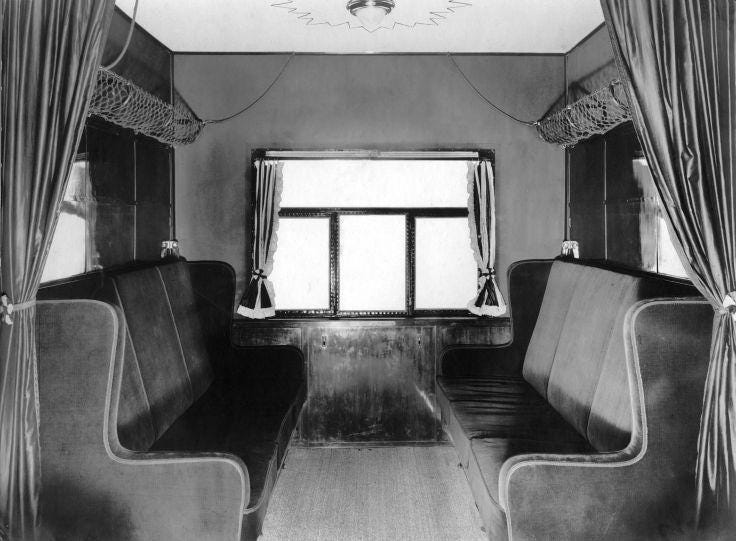
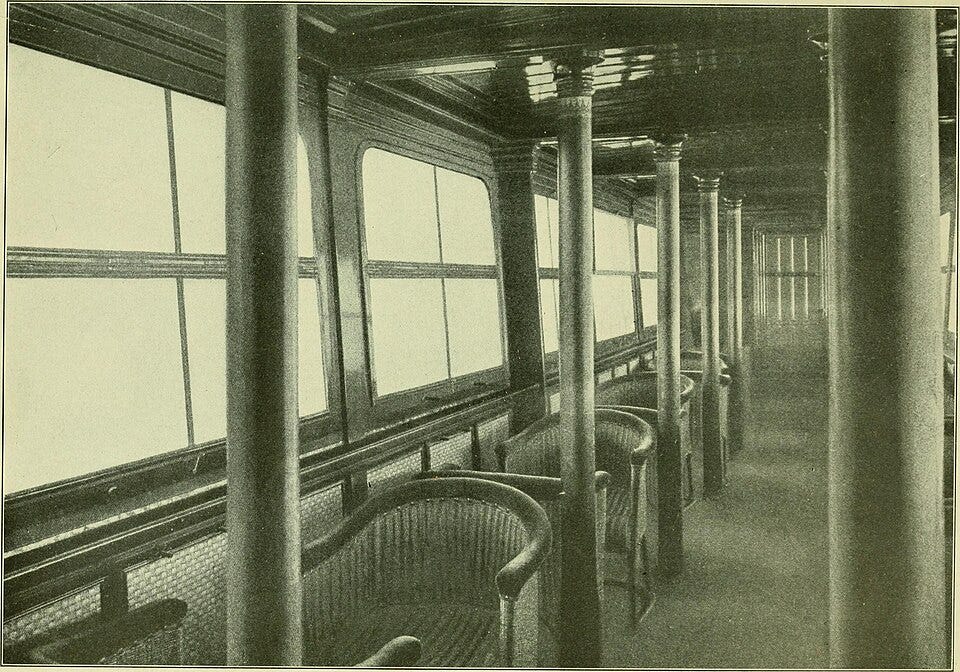
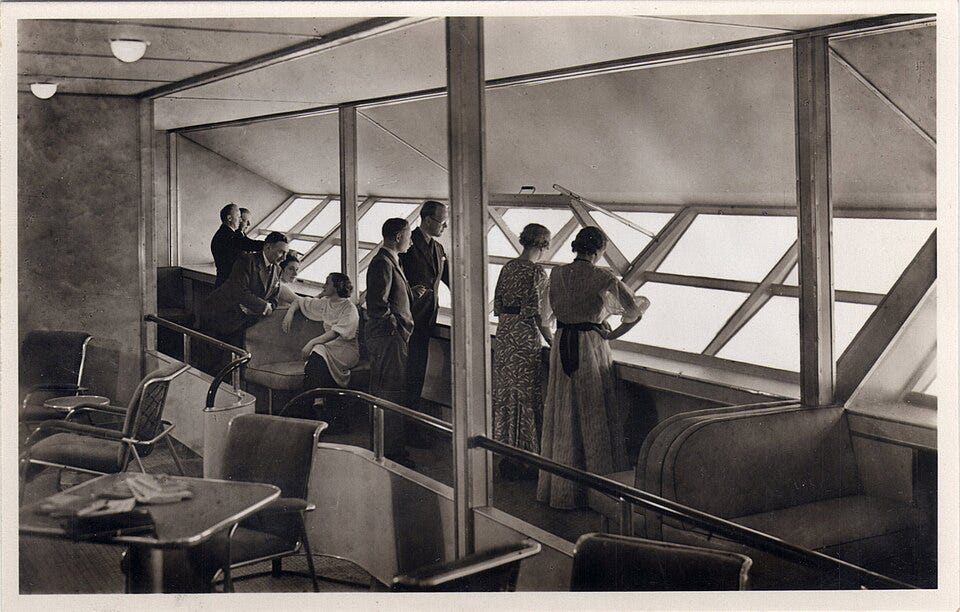
There’s probably not much to do as a passenger as every amenity adds weight; the main attraction are the views, which might only be available in common areas (many Hindenburg cabins had no windows). The ship travels relatively slowly, so windows can be opened for fresh air. Airships flew low, especially in our higher-density atmosphere; the view would be similar to the one you get as an airliner is climbing away from the airport, with individual people and cars visible on the ground.

Real-life airships had surprisingly high crew ratios, with around 1.2 passengers for each crewman. In the control car, you had six to ten men - a captain, navigators, and men manning the controls of the rudder and elevators. There would be an engineering staff of six to ten on duty at any given time - one mechanic in each engine gondola, plus some extra hands. Add another five men on duty as riggers in the bowels of the ship, managing the gas cells and outer covering, and another two radio operators in a dedicated internal room. All of these roles needed to be covered around the clock, so multiply these numbers by three to cover the different watches. Airship watches were short - just a few hours - because of the more intensive management required compared to a sea vessel, and because of the conditions in places like the engine cars.
And of course on a passenger ship there was a complement of another five to ten men working as stewards and cooks - essentially flight attendants, though again you can imagine this number declining in a world of mass travel.
The crew quarters and places like the radio room were tucked up into the keel of the ship, a sort of corridor in the frame that ran along the bottom of the ship’s envelope, with passenger cabins spreading out from this structure. Crew accommodations were hammocks strung from the frame to either side of the central catwalk for most and cramped bunk beds for officers.
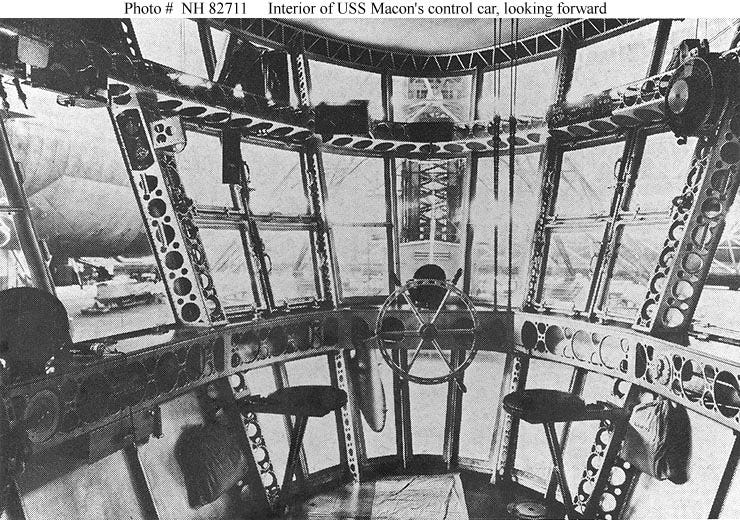
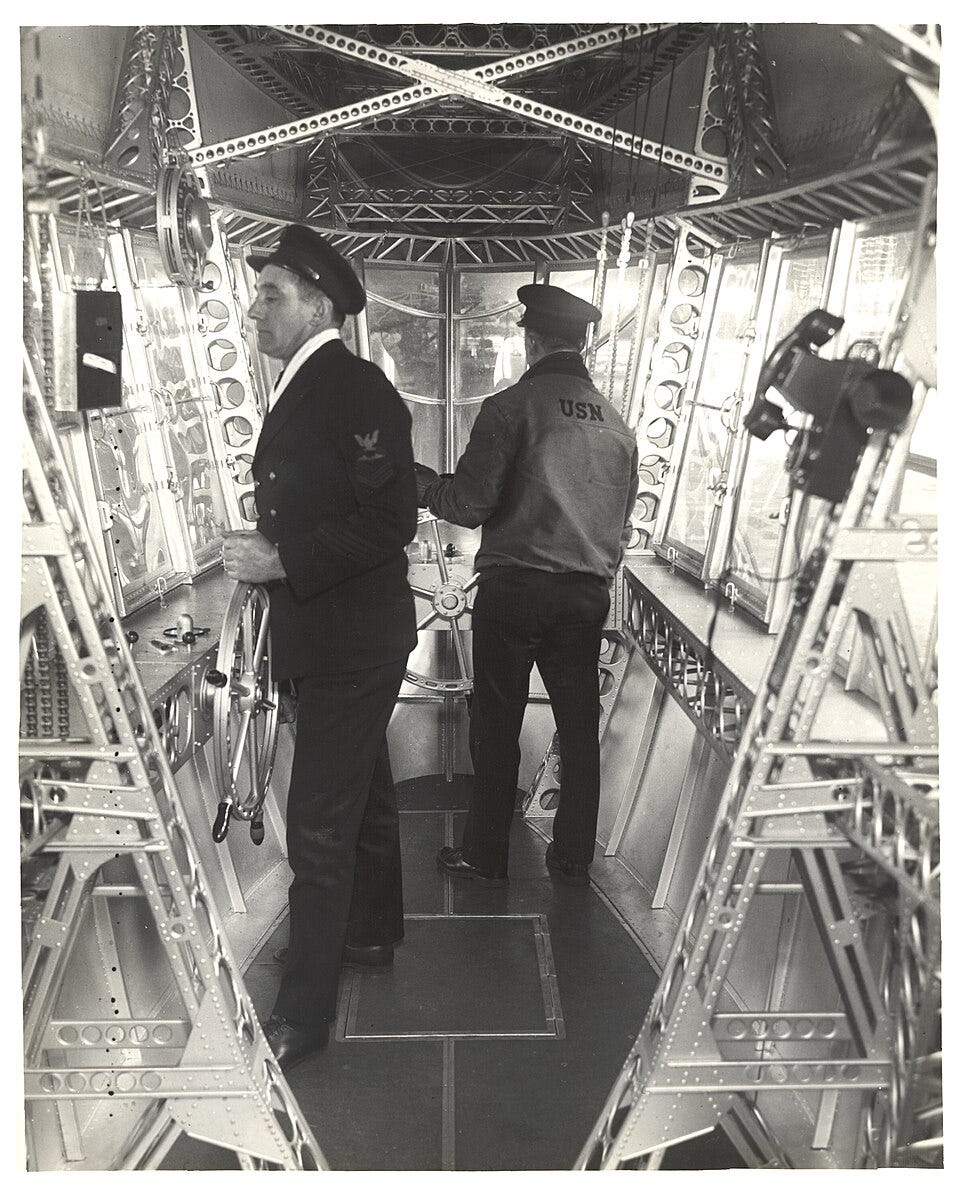
The control car itself, the bulbous part sticking out from the envelope at the front of the ship, had three sections on later airships: a bridge with the ship’s controls at the front, a map room behind that for the navigators, and a private lounge behind that which was used for crew meetings.
Controls in the bridge included wheels to adjust the rudder and elevators, switches for each gas cell for releasing hydrogen, the same for each water ballast tank along the hull, and mechanical telegraphs for communicating with each engine car. The latter were used to tell the mechanic in each engine to set a certain RPM and what direction to drive the propeller in; there was no direct connection between the engines and the bridge controls due to the distances involved. The Hindenburg also featured a mechanical autopilot that used a gyroscope to maintain heading and altitude.
The decision loop for officers mostly involved managing balance and lift. The properties of the lifting gas in the cells and their environment were constantly changing - pressure, temperature, humidity, and wind were all in flux. Rain added weight to the ship’s envelope and required ballast to be dumped to maintain altitude. Small adjustments were constantly being made - water moved between ballast tanks or dumped, gas valved from certain cells, and adjustments made to the elevators to keep the ship level for passenger comfort.
The last point above is the reason why the job of elevatorman was one of the most difficult positions aboard and only given to senior airmen. Even theoretical cargo ships would want to keep themselves within a few degrees of level to protect the crew, engines, and structure.
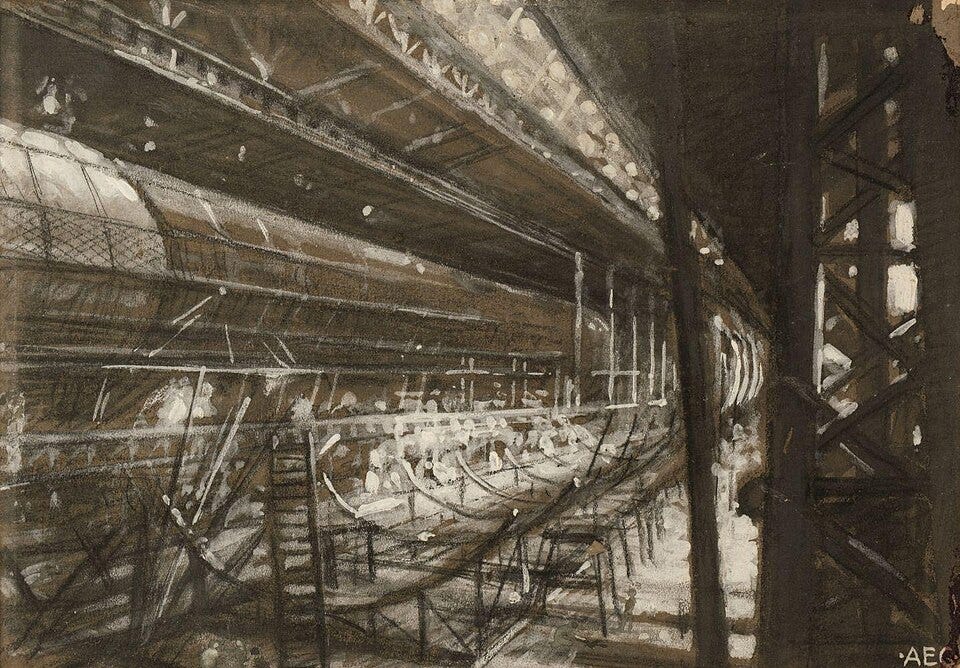
Within the ship, riggers clambered around the cavernous hull on catwalks and ladders to check the gas cells for wear, leaks, damaged valves, or other issues. Tears in the outer fabric covering could be dangerous or debilitating for the ship, so they needed to be ready to make repairs in flight if necessary - like those conducted to one of the Graf Zeppelin’s tail fins during its first transatlantic voyage. They also maintained the control cables that linked the bridge to the ship’s distributed systems like the engine telegraphs and ballast controls.
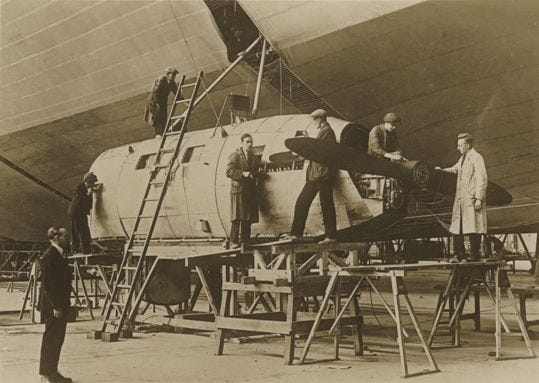
Airship engines were high-performance, temperamental things. Mechanics in the engine gondolas needed to closely monitor their charges for any issues and even sometimes improvise repairs while the engine was running. More commonly, the engine would be dialled back or shut down to preserve it at the first sign of trouble. Later airships had little trouble running with some engines out, which did necessitate lower cruising speeds. Failures usually required someone to physically head down and inform the bridge, as the engine telegraphs just told the mechanics what speed to run at and allowed them to acknowledge the orders. The Hindenburg had an internal telephone network that made this sort of communication easier, however.
Speaking tubes were used on some ships in areas where electrical circuits could not be tolerated, such as among the gas cells. This is also a reason for the use of mechanical rather than electrical telegraphs for communication. The crew wore anti-static clothing and rubber-soled shoes to reduce the risk of igniting a fire in flight - as we saw in the previous weeks, a virtual death sentence for all on board.
It goes without saying that there was a lot of precarious clambering involved in these internal postings. Access for engine gondolas consisted of insubstantial wire/rope catwalks or ladders over open air, while riggers spent their days at heights never seen by their seaborne counterparts. Actually leaving the ship’s envelope, however, was reserved for emergencies, except for the brief sojourns made by mechanics to access the engines at the beginning and end of shifts.
The most dangerous phase of flight was the landing. Most crew had special assignments during this procedure; there was a man assigned to each part of the ship to monitor every system. Rather than having a single captain on watch, command was tripartite: two captains served as watch officers, with one managing rudder and engines and the other elevators, ballast, and gas, and a final captain observing, ready to intervene or adjudicate disagreements. The elevator officer usually - but not always - had precedence over his companion on the rudder. A notable example is the final landing of the Hindenburg:
Standard textbook practice, as laid down by Eckener, was for the captain of the ship to stand aloof from the watch officers and let them perform their duties, supervising them closely, of course, and intervening only if a disagreement or a sudden problem should arise. Thus, one officer was in charge of the rudder and engine power, while another looked after the elevators, ballast, and gas.
On this flight, however, there was a more specialized division of labor. Pruss himself took over the rudder and engine position, while First Officer Albert Sammt supervised trim and altitude and Eduard Boetius manned the elevators. Sammt also directed Watch Officer Walther Ziegler, charged with overseeing the gas and valving, and Second Officer Heinrich Bauer, handling the ballast.
Lehmann’s role was vague. As he was the senior officer on board, perhaps Pruss had pliantly deferred to his wish to command the landing, or perhaps Lehmann had long hankered to get rid of what he saw as Eckener’s outmoded policy and had ordered a change in the hierarchy.1
(Empires of the Sky, ch. 50)
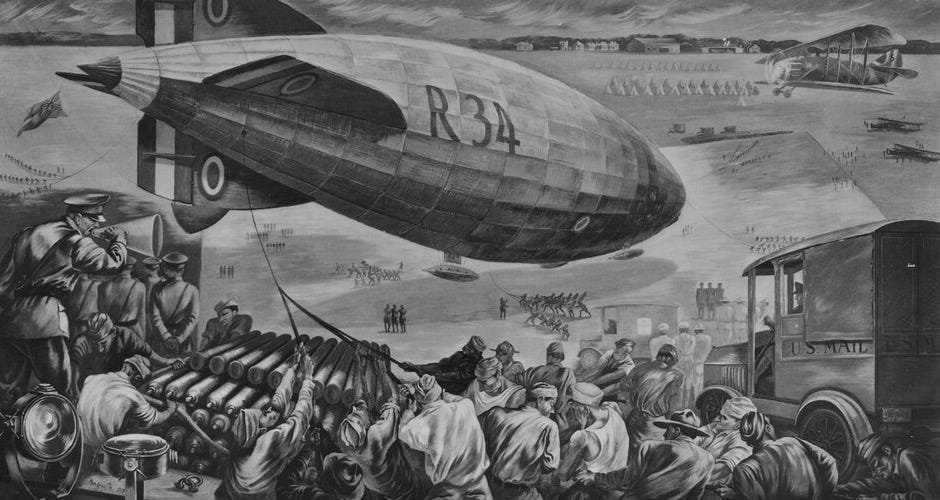
As the ship approached the mooring mast it dropped several lines to the ground, which were taken up by a crew of hundreds who pulled the ship in for the final approach to the mast. These crews had to be careful - gusts could lift the ship by dozens to hundreds of metres, and there were several historical deaths caused by men who failed to let go of their line in time.
Trackless roads
An economy that runs on airships as its primary mode of transport would have some quirks.
Firstly, supply chains. You might expect a supply chain for hydrogen; but it’s so annoying to handle and transport it’s more likely that the hydrogen is produced on location and on demand at airship mooring facilities. All you need is electricity and water, and the electricity can be obtained through the fuel supply chain the airships already need. It does need a lot of electricity, so alternative sources would be attractive. And if the ships have buoyancy compensation like water recovery systems the need for this would be significantly reduced - the infrastructure is a minor component rather than a load-bearing part of the economy.
Airships are fast compared to the logistics networks of early modern or even 20th century; even in our denser atmosphere from Part 3, twice that of Earth, they cruise well around 100kph. Point-to-point speeds are on par with modern trucking networks, and terrain is no trouble. As soon as a remote area builds a mast and mooring station, they can take full advantage of the regional shipping networks. Frontier expansion becomes much easier, but this makes the same frontiers less wild. Interior cities look more like coastal ones, compared to our world where ocean shipping dominates.
Speaking of masts, they’re everywhere. Mast construction is a huge industry and tall masts - probably taller than the ones used in reality to allow ships to rotate with the wind and reduce ground crews - dot the landscape. In contrast, hangars are rare and hugely expensive. These airships are spending most of their lives exposed to the elements. I think the right way to think about hangars is as the equivalent of a drydock for airships. There are a decent number of these, but they’re concentrated at major hubs and each ship only sees the inside of one rarely.
The exception to this hangar rule is perhaps small blimps, but not semi-rigids. A pure non-rigid could have its balloon fully deflated for storage and kept or maintained in an aircraft-sized hangar. However, the benefits of this would probably be outweighed by those of going to a semi-rigid design that doesn’t pack down so neatly. I’m not completely clear on how this would shake out, but it’s something to consider.
Because of the sheer size and versatility of airships, oversize cargo becomes much less of a hassle. This is a proposed real-world use case for airships - handling things like wind turbine blades - and it would likely have some effects, particularly for prefabricated buildings. On the other hand, very short hops seem inefficient, both due to the difficulty of mooring and the slow rates of climb necessary in our higher-density atmosphere. Airplanes, sea vessels, and ground transport would certainly dominate in many niches like that one. Bulk cargo still travels by sea or rail where possible.
Because most consumer goods would probably travel by airship, there’s a pressure towards weight reduction you don’t see in our world. A lighter but otherwise equivalent formula for baby food translates into real cost savings for the consumer in a way it doesn’t for us.
Something that does become much more of a hassle is the weather. Part of the reason you want to accept tradeoffs to get more predictable weather (covered in Part 3) is that the economy now runs around the weather. On the other hand, there aren’t really shipping bottlenecks, unless they’re geopolitical in nature. The latter would be easy to enforce; airships are easy targets, as we saw in Part 1. Weather forecasting would become a very lucrative activity; it’s easy to imagine prototypes of modern high-frequency trading firms developing, or mages finding that weather forecasts are the best use of their time.
Cultural considerations
Airship dominance would undoubtedly have a lot of downstream effects on culture, but what might these be?
We can begin with the obvious - those crew roles I described earlier would be a significant part of society, akin to the archetype of the first mate or the midshipman in reality. The “airman” - by the book, steady, serious - would be its own stock character most members of society would be familiar with.
English has inherited dozens of phrases from the maritime world - “by and large” from sailing both “by” and “large” the wind, the “offing” originally being the area of open sea visible from shore, “hand over fist” as the method of hauling a line in quickly, “feeling blue” from the signal flag for a dead captain, and many more. Undoubtedly our fictional societies would develop their own inherited lexicons.
Airships themselves, and the industry around them, would occupy an interesting position in the popular imagination. I think the best example is the car industry in the middle of the 20th century: a pinnacle of technological achievement, but also something fairly mundane that has penetrated into every corner of life in developed nations. But airships have that aspect of the spectacle about them, which seems like it would change this picture. This could give movements similar to high modernism and general technological optimism from the early 20th century longer legs.
It’s also interesting to consider what the mountain-striding properties of airships would do to an early modern society. It seems like this would lead to a ‘flattening of the world’ earlier on in history, with cultural trends quick to propagate and frontiers blending into imperial centres. There isn’t a 24-hour news cycle here, we’re still at the technological level of radio or even before, but airships provide a physical backbone to complement the cultural effects of these new communication technologies. Rather than a gradual evolution of existing networks like railways (which are themselves basically a type of road) or ocean vessels, airships would be a totally new mode of transportation, and ones operating on a mass scale beyond anything airplanes achieved in the 20th century.


_(25403982913).jpg)


So airships are unifying, but on the other hand they’re slow in some ways. They have a particular speed, one that’s proven pretty amenable to people, which they reach and then plateau at for fundamental drag reasons. And in our denser atmosphere, fast aircraft are much more expensive, so it’s possible the ceiling on our society’s clock speed caps out and stays lower for a few decades. On the other hand, you still have radio and television. But a movement like Futurism still seems out of tune with an airship society.
The border-defying nature of airships was a central point of concern in the early 20th century. This seems like an important factor too; not just in the ability of airships to link nations into tight commercial webs, but also in the creation of a new class of ‘world citizens’ (both crew and passengers) relatively early on the tech tree.
There are also likely consequences for exploration. Mass adoption of airships means first contact with isolated peoples looks more like a visit from Captain Kirk than some construction company slashing and burning to cut a new road through the jungle. It would also probably put a damper on any heroic age of exploration going on at the time: there were several attempts to use airships to reach the North Pole in reality, which would have been a lot easier than the overland route, but this never quite worked.
The way I would sum this up is that airships seem like peaceful technology. They’re terrible for warfare; for those in a world woven around them, they’re a symbol of commerce, globalisation, perspective, and stately progress. You can easily imagine the great trading airships as heralds of peace, the first sign to appear over a war-torn nation that the conflict is over and normal life can resume. And travelling by airship is aristocratic in the sense of that final leisure class upended by capitalism.
There’s a strange tension here between the traditional role of airships in Earth’s fiction and the way they would likely be perceived in one of these fictional worlds. At once they are all-powerful and powerless, symbols of industrial terror and progress, and dominators that give succor to the weak.
Ultimately the side that they fall on is up to you. I can only hope that, wherever they go, this series of posts might let your airships strike out into their new world with a destination in mind.
Empires of the Sky (2021), Ch. 50.