
Worldbuilding Guide: Airships - Historical lessons
Why didn't real airships work out?

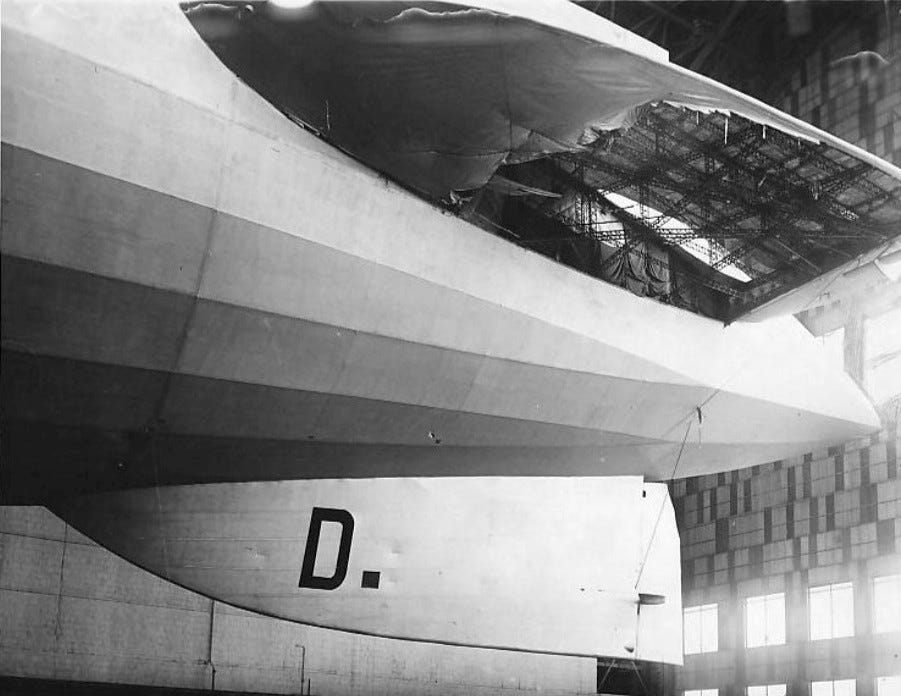
It is a truth universally acknowledged that a fantastical world in possession of flying ships must be in want of a magical lifting device.
I’ll be a little more blunt than Austen: must it? Airships are all over genre fiction and have been for some time. It’s not hard to see why, but they’re usually set dressing or reliant on magic to function. I’d like to see more settings take airships seriously, and I think popular conceptions of them get a lot of things wrong.
That means details, though. This is the first instalment of a four-part series covering everything I think matters. Here’s what we’ll cover, starting with #1 this week:
A brief history of real airships and why they disappeared.
How airships have been used in fiction, with a focus on the fantasy genre.
The design of a fictional airship in detail and how we can modify her world to suit.
How a society and economy dependent on airships works around the ships themselves.
A brief history
Before we get to powered airships we should start with balloons to make a distinction clear: airships are high-tech and somewhat useful, while balloons are low-tech and not very useful.
Balloon flight sprang onto the pages of history during the 18th century. In 1709 a Jesuit priest, Bartolomeu de Gusmão, wowed the Portuguese court with a small, unmanned hot air balloon. By 1785 Jean-Pierre Blanchard was crossing the English Channel in a hydrogen-filled balloon with steering and human propulsion in the form of oar-like “wings”. Blanchard became a hero and drove a public obsession with balloons that lasted well into the 19th century, even after he died in 1809 from injuries sustained in a balloon accident.
It’s not surprising that manned balloons appeared so suddenly; the concept was a simple one, and the basic principles of buoyancy had been understood in Ancient Greece. Earlier thinkers had described the concept but lacked the raw materials to build a working prototype. Instead, a few technological developments in other areas made Blanchard’s balloons possible. de Gusmão used what was available to him - heated air from a fire in a clay bowl and a paper envelope - but by the late 18th century the picture was very different. In the 1760s, Henry Cavendish characterised hydrogen for the first time, calling it “inflammable air” but recognising its very low density. The Enlightenment had resulted in a much more developed scientific supply chain across Europe capable of producing and handling large quantities of gas, for the first time enough to fill a balloon.
At the same time, significant progress had been made in the manufacture of textiles and treatments for these. Better, more consistent large-scale weaving was available. Paper was cheaper - the Montgolfiers were paper manufacturers. Varnishes, oils and resins that had been developed for waterproofing fabric or surface treatments could be repurposed to seal a gasbag and slow the leakage of very light gases like hydrogen. These advances mostly spilled over from the maritime industry; colonisation, naval warfare, and international trade were all of paramount importance during the period. The early stages of the Industrial Revolution also played a role: an early lifting gas was coal gas, a fuel produced by gasifying coal which is 50% hydrogen.
But the key factor that held back airship development was the same as aircraft: engines with a good enough power-to-weight ratio. This might sound odd since airships float: couldn’t you just use a low-performance engine and travel slowly? But the engines also need to be able to overcome forces from the wind, which are large, as your balloon acts as a massive sail. Blanchard’s “oars” weren’t good enough.
So both gliders and balloons were built quite early on in history, but pioneers quickly recognised engines as a problem. George Cayley, working in the early 19th century, had all the basics of aircraft figured out. He understood the design of fixed wing aircraft, developed the basics of aerodynamics, and built gliders able to carry people. But he realised existing engines just weren’t light enough to make powered aircraft viable, and gave up after several experiments including a primitive gunpowder-powered internal combustion engine. Early balloonists came to the same conclusion despite attempts to use electric motors and steam engines.
Airships and aircraft would both have to wait until the early years of the 20th century when sufficiently powerful internal combustion engines would be developed. One of the pioneers of this field was Wilhelm Maybach, who happened to be based in the same area of Germany as one Count von Zeppelin.
Zeppelin had been obsessed with the idea of powered, rigid airships for years. After being forced out of a three-decade military career due to a political spat, he was free to devote himself to his passion, which he also saw as a way to restore his honour.
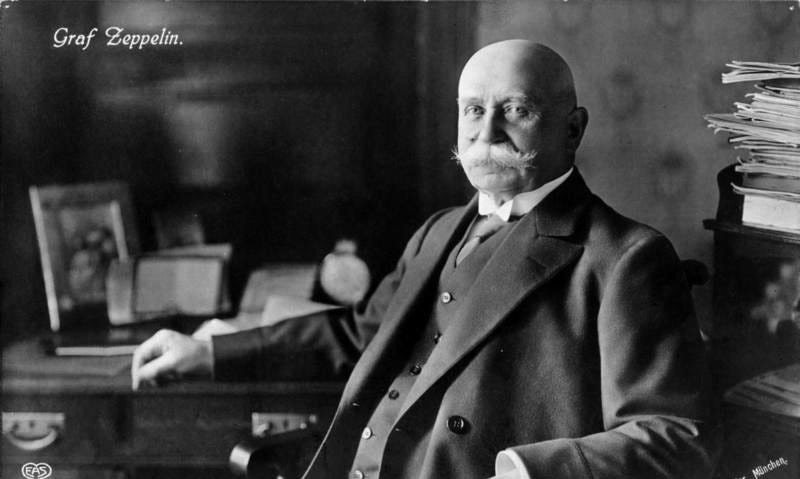
It turned out he had exactly the right mixture to make it work. Connections, obsession, timing, proximity to Maybach for engines and the world’s greatest chemical industry for hydrogen, and most of all lunatic optimism. Even so, it was a near thing. Zeppelin’s early struggles to get his idea off the ground mirror those of modern hardware success stories. He put everything he had into the project, eventually mortgaging his wife’s estate to pay for construction costs1. He struggled to win over institutions but persevered anyway. He almost failed after technical problems destroyed his first two airships, but his third finally worked in 1906. This unlocked enough public support and government funding to keep scaling up.
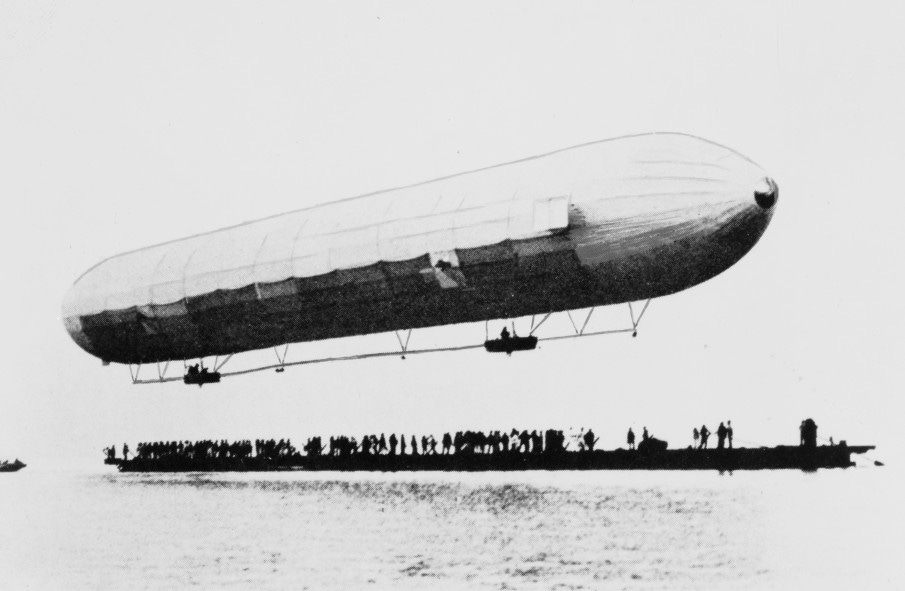
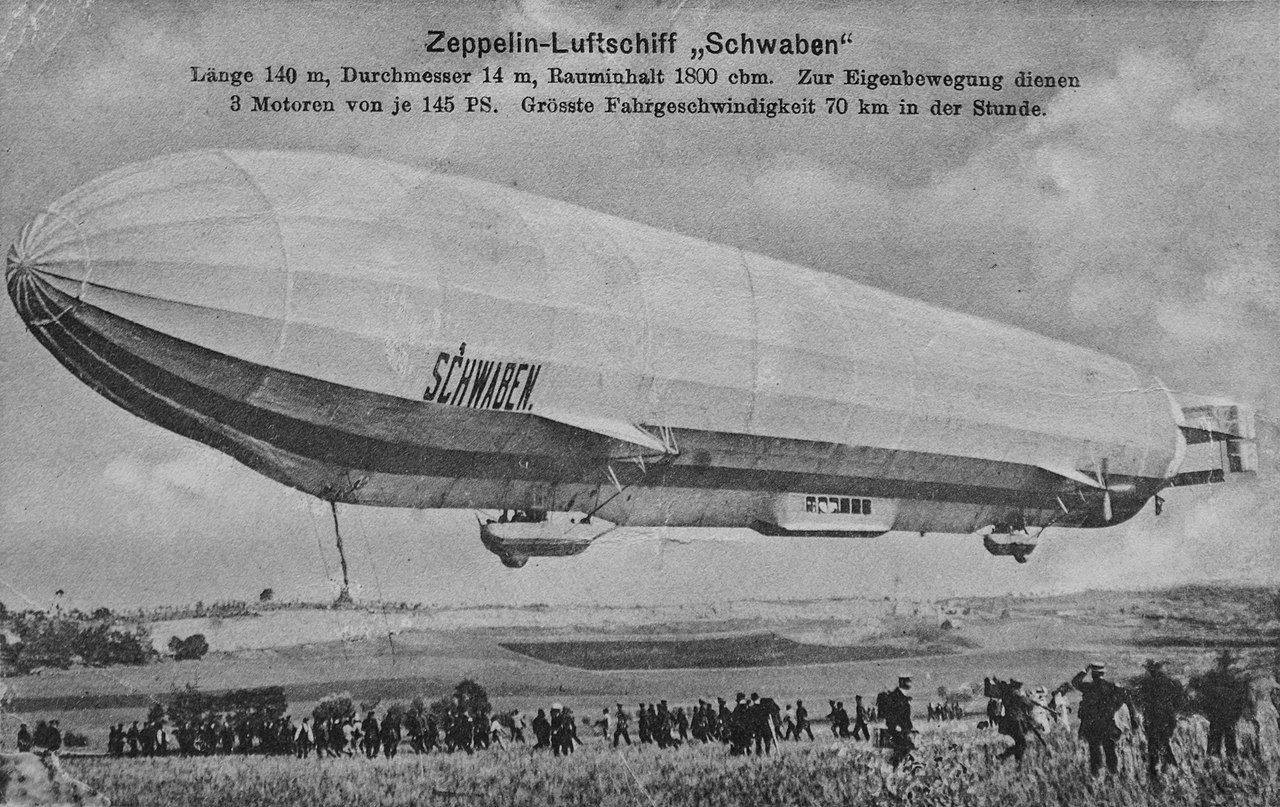
It’s from Zeppelin that we get the basic layout of a rigid airship - a streamlined fabric envelope stretched over a complex aluminium structure containing a number of separate gasbags, with piston engines and passenger gondolas mounted to the frame. This contrasts with a non-rigid airship, which is essentially a single soft balloon with engines and a gondola attached to it.
The following years saw the Zeppelin company significantly refine their designs and build successively larger airships. Count Zeppelin’s eventual successor as head of the Zeppelin company enters the picture at this point: Hugo Eckener, an interesting character who was one of the best-ever airship captains and a master publicist obsessed with the dream of transatlantic airship service.
Eckener was involved in the establishment of the world’s first airline, DELAG, in 1909. They flew a handful of airships on regional routes throughout Germany and actually did quite well. Cabins were full, the experience was comfortable and safe, and the whole thing was looking almost profitable before World War I intervened.
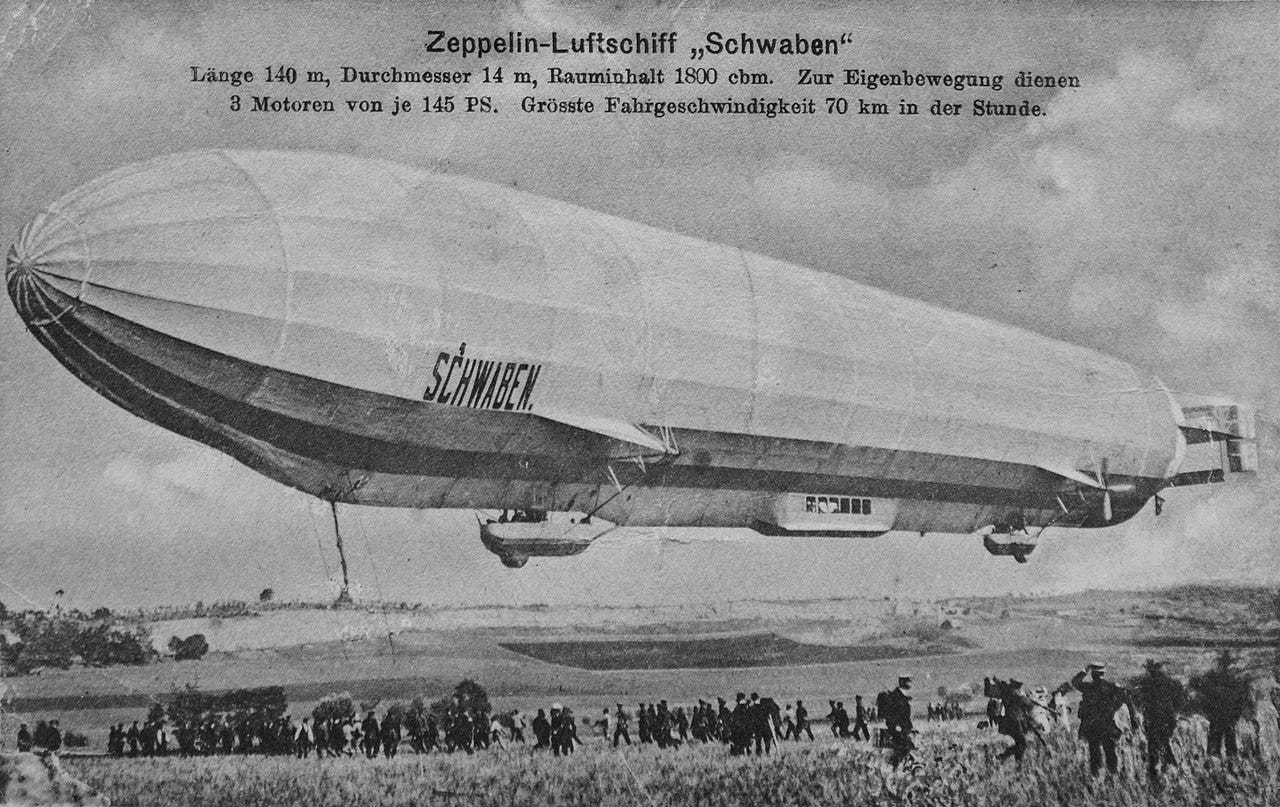
All of the DELAG ships were seized for the war effort and proved quite useless in combat. Airships were just too vulnerable. Early on there was some success on scouting missions and raids until the enemy developed countermeasures. Bombing never accomplished much - some Zeppelins could carry out long-range missions with over five tons of bombs, more than twice the load of a World War II bomber like a B-17, but aerial navigation and aiming was so primitive that these virtually never hit anything important. And the Germans operated less than a hundred Zeppelins over the entire war compared to a production run of over 12,000 B-17s.
That last point is important. For the amount of attention they get, there really were only a tiny amount of proper rigid airships built during the 20th century. And often new airships would only last weeks or months before being wrecked. I’ll return to this later, but it’s a key reason why airplanes eventually won out.
The German government poured huge amounts of money into Zeppelin construction during the war, producing dozens of ships. It was the largest fleet of rigids ever built. But by the later years of the conflict, Britain and France had fighter aircraft with incendiary ammunition which could easily chase down and set fire to a Zeppelin (a death sentence for the entire crew). More sophisticated anti-aircraft defences were built in cities, with networks of searchlights and high-velocity guns. Many Zeppelins were lost almost as soon as they were sent into the field and a morbid atmosphere developed amongst the crews, most of whom would be killed pointlessly during the course of the war. A typical example was L-19, whose first and only mission destroyed a British pub and several farm animals; during the return journey its engines failed and it crashed at sea, killing the entire crew.
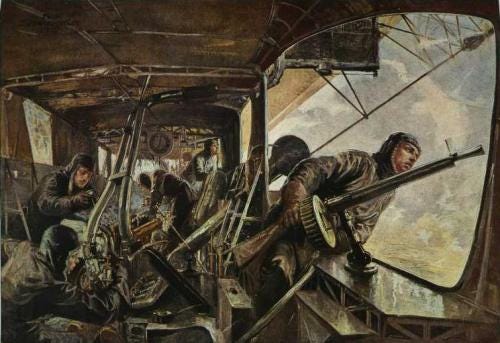
In a case of real-life foreshadowing, two zeppelins were destroyed on the ground in July of 1918 by British aircraft launched from the HMS Furious. It was the first carrier-based airstrike in history.
The only reason the government continued the program was propaganda and intense lobbying from a few key insiders, including a captain who would later die in a downed Zeppelin that even Eckener considered obsessed with airships2. Ludicrous estimates of the bombing campaign’s efficacy were swallowed whole at the highest levels of the German government - death tolls in the tens of thousands for single missions and the idea that Britain was devoting a million men to its airship defences were accepted fact3.
Ultimately only 16 of the 91 Zeppelins operated during the war would survive4, but all this construction and flying rapidly advanced the art of Zeppelin design and flying. The Germans were hobbled by the treaty of Versailles and the postwar conditions, but they (specifically, the Zeppelin company) were and would remain far ahead of anyone else in the business of building airships.
After squeaking through the tough years immediately following World War I, Eckener continued his pursuit of larger and larger airships, the aim being to build one big enough to institute a transatlantic passenger service. This was finally achieved in the late 1920s with the Graf Zeppelin, which was followed up by the Hindenburg in the 1930s. But these were to be the pinnacle of rigid airship design, and interest never returned after the latter was destroyed.
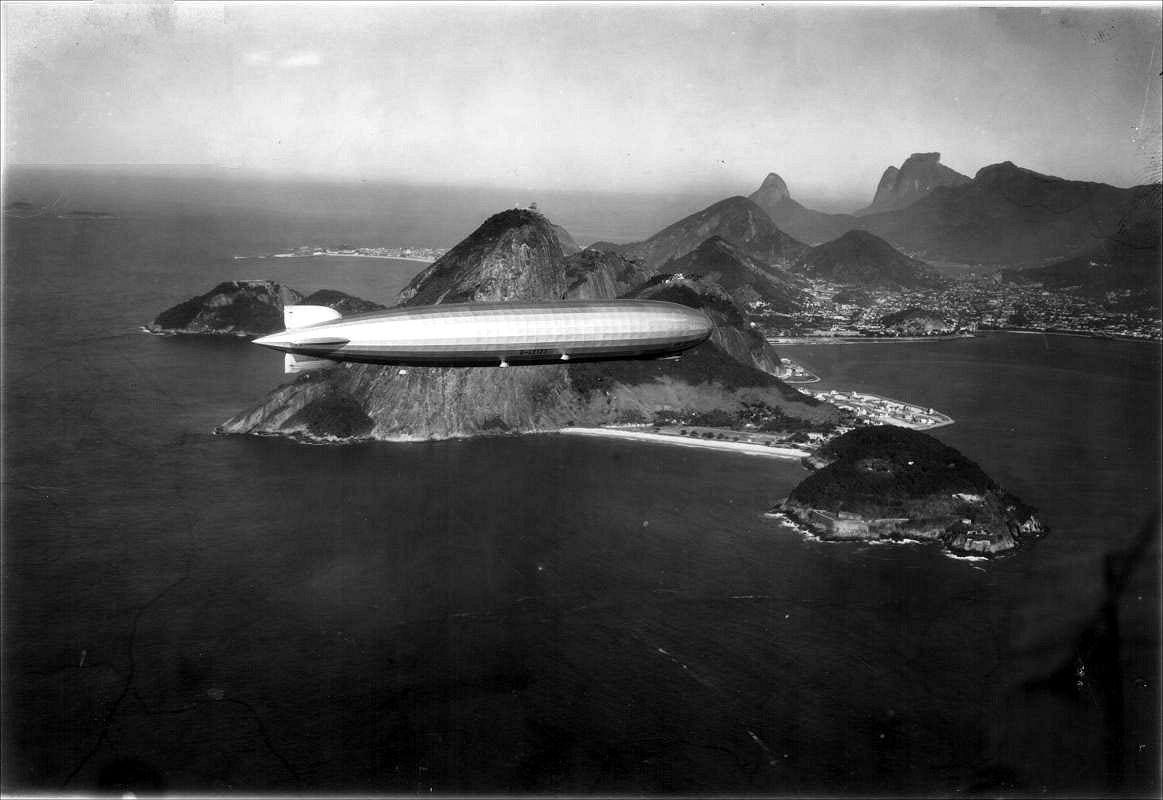
This wasn’t quite the end of the story for airships.
The US built some large rigid airships in collaboration with Germany in the interwar period. These were planned to be used for naval scouting in the Pacific to counteract Japanese aggression, but it all came to nothing after several high-profile disasters. However, American naval airships would get a second wind during World War II.
A fleet of smaller non-rigid blimps proved to be very good submarine hunters and naval escorts: arguably the most successful use of airships ever. They consisted of a helium-filled balloon with a control car hanging beneath, which had room for a few crew members, engines, radar, magnetic detectors, and a handful of depth charges. They had excellent endurance for long-range patrols and escorts across the Atlantic. Airship bases in Europe and America could provide better escort coverage for transatlantic convoys than land-based aircraft. They were better suited to the low and slow flying that was ideal for submarine interceptions. Unlike ships, they were immune to torpedoes and could easily run down submarines, with cruising speeds around 50 knots or 90 km/h.
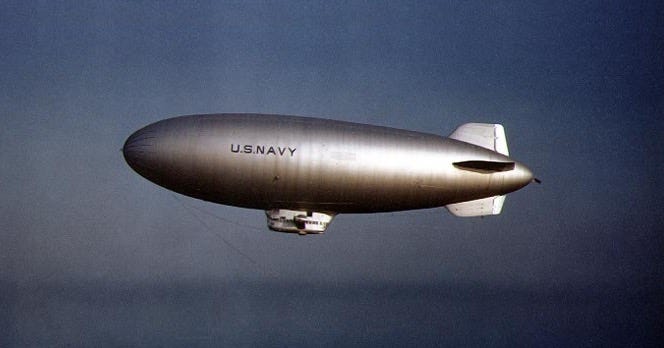
Only a single blimp was lost in combat, and only one ship in a blimp-escorted convoy was sunk by a submarine. By the end of the war the Navy had built over 150 in classes of increasing size. This culminated in the 1950s with the N-class, the largest of which were around half the length and a quarter the volume of the Macon, one of the helium-filled US rigids from earlier years.
There’s obviously a lot of detail I’m leaving out: all the weird experimentation with early balloons, rivalry between early airlines like Pan Am and Eckener’s Atlantic ambitions, the various phases of Zeppelin development, failed overseas programs, strategic fights over helium supplies, and so on. But this is tangential to the core issues around airships.
I think early history, of unpowered balloons and so on, isn’t that relevant. They were so impractical they were never really useful for more than spectacle, and the quality of early balloons was poor enough they would have made bad airships even had propulsion been available. A fantasy solution at that tech level would, I think, lean heavily on magical alternatives.
All that said, there are a few things to take away here.
The pattern throughout the first few decades of the 20th century was for countries to become interested in airship development, build a handful of ships that the Germans considered inferior pieces of junk, destroy some in terrible crashes, see how expensive the whole enterprise was, and give up. The cost wasn’t just about the shipbuilding. Constructing an airship hangar was a vast expense, a landing site had a ground crew of dozens to hundreds of men, and ships valved thousands of cubic feet of hydrogen into the air on every voyage for buoyancy control.
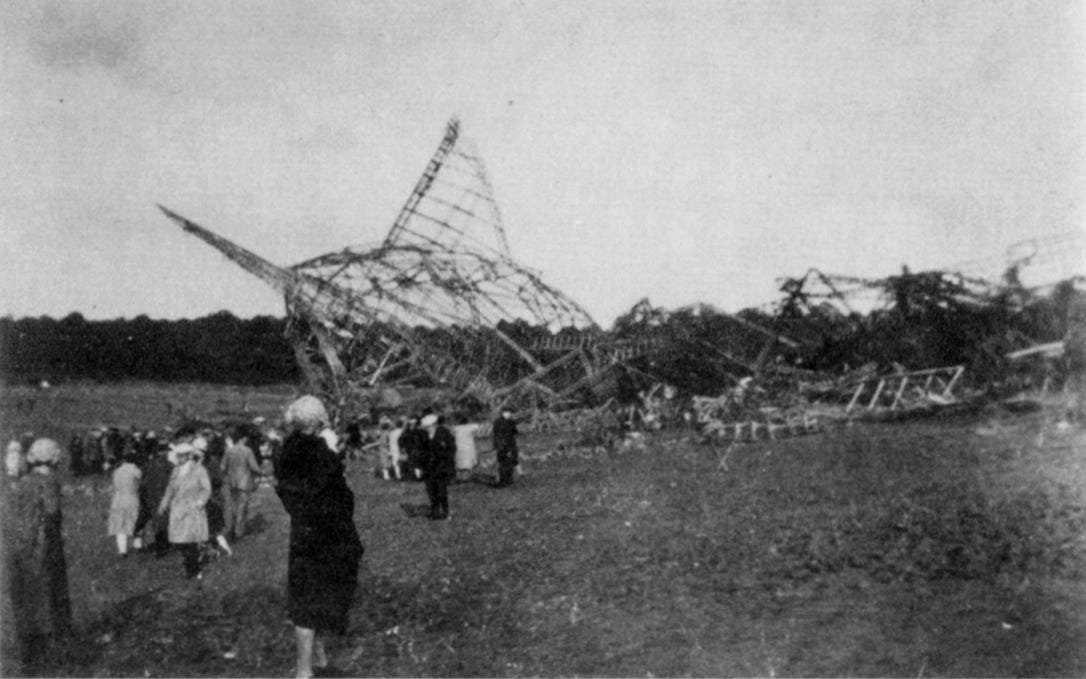
A good example of this pattern is Britain. Large airships were seen as a way to unify the far-flung British Empire, and two parallel programs were spun up in the 1920s to build prototypes: one government and one private. The novelist Nevil Shute (best known today for On the Beach) and Barnes Wallis (later to develop the “dambuster” bouncing bomb during World War II) both worked in senior roles on the private program. The “capitalist” ship, R100, was more conservative, while the “socialist” R101 pushed boundaries with innovative structural designs and extensive use of prefabrication, as well as a more refined aerodynamic shape. However, both were significantly delayed and did not fly until 1929. In 1930, R101 crashed on its first long-distance flight to India, coming down over France and killing virtually the entire design team as well as a thicket of important officials. The death toll of 48 was a dozen higher than the Hindenburg disaster. British involvement in airship development ended overnight; R100 was grounded and scrapped in 1931. One aspect of this that was repeated in other contexts was that all the leading airship advocates in Britain were killed in R101’s crash, leaving the movement rudderless.
Another pattern was that airships were far more famous than they were practical. Similar to the earlier mania about balloons, airships were a massive public spectacle, partly because they were so rare. New generations often consisted of a single ship built by the Zeppelin company, which would then top headlines around the world by achieving some feat (often financed by media interests or the government) and draw enormous crowds. Eckener was, for a time, one of the most famous men in the world and stood shoulder to shoulder with Charles Lindbergh.
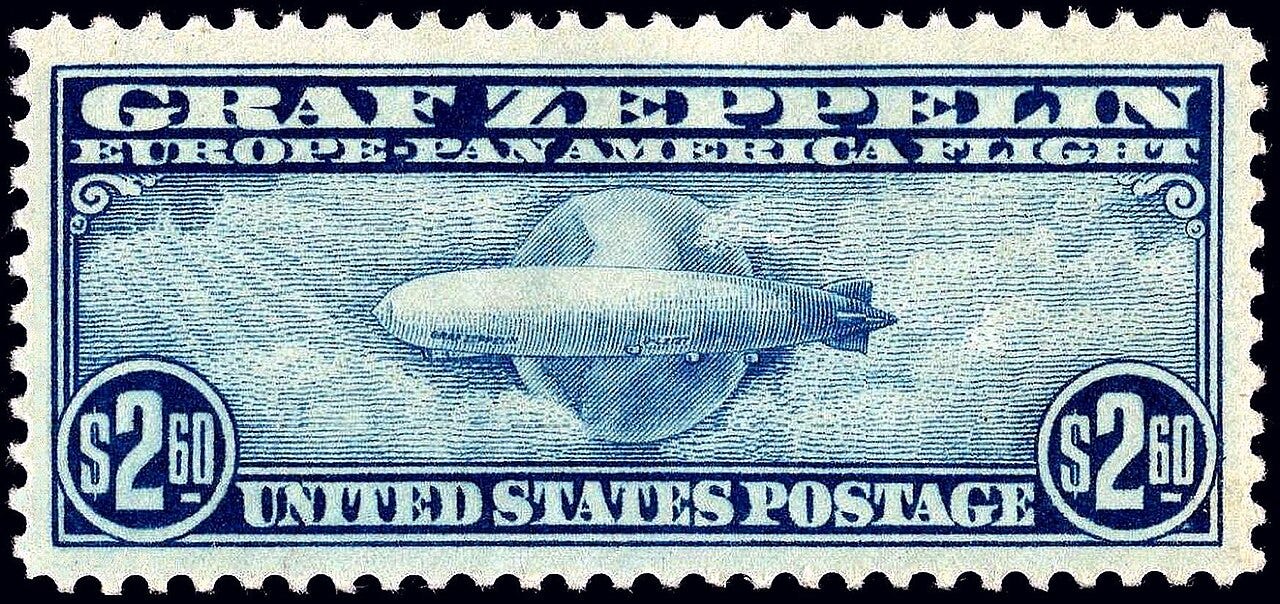
Sometimes this was useful, as when Zeppelin raised the equivalent of around $40 million in 2026 dollars using a literal crowdfunding campaign from the German public following an airship loss5. At one point during the Great Depression, Eckener was financing transatlantic flights of the Graf Zeppelin by selling commemorative stamps6. But these hardly made for a sustainable business model.




Another question is safety. In my view, this is a mixed picture. Airships were remarkably safe, given that they were well-built ships operated as civilian vessels by experienced crews. Just like other kinds of air travel it took time and experience to develop safe practice for handling airships. Most nations never had enough Zeppelins to learn these lessons before their programs were wound down: their first attempts were usually flawed designs piloted by captains who didn’t really know what they were doing. This was the root cause of many program-ending disasters.
But with a good ship and crew, all the main risks - weather, hydrogen, dangerous thermals, engine failure, and so on - could be managed. Graf Zeppelin, which crossed the Atlantic over 140 times with zero injuries7, is proof of this. The flipside is that safety was not so much about big decisions like using helium instead of hydrogen or avoiding storms entirely, but about getting every little thing right. Eckener’s airship operations were more like a modern airline in this regard. This explains the dozens of airships that crashed almost immediately after being completed.
There’s also the civilian caveat. We’ve seen that airships were just too vulnerable as a main aerial force, but they would later show promise in narrow roles as naval scouts and submarine hunters.
This contrasts with aircraft. Early planes crashed all the time and killed huge numbers of people. Air travel got off the ground because of a population of early adopters who were willing to risk a meaningful chance of death to get to their destinations slightly faster or see the world from above. But that was OK, because aircraft were much easier to build, so huge numbers were constructed by an ecosystem of competitors. Compare this to airships, where only a couple of hundred were ever built and Zeppelin maintained a decades-long monopoly on the technological state of the art. Aircraft offered many more chances to learn how to fly them properly and so they eventually became safe, despite being much more dangerous than airships in the beginning.
This is another point that deserves emphasis. For a couple of decades at the beginning of the 20th century, expert consensus was that airships were the future and aircraft were too short-ranged and dangerous to be consequential. “Aircraft guys” were crackpots. Compared to the devil-may-care world of early aircraft, airships were a picture of comfort and safety: commercial airship passengers went 27 years without a single injury until the Hindenburg disaster.
And passengers were what commercial airships mainly carried. Wealthy passengers, too. A good way to think about the Hindenburg and Graf Zeppelin is as a Concorde equivalent, where the subsonic jetliners in this case were trans-Atlantic steamships. Freight was never seriously considered, as ocean-going ships could carry far more weight, and the speed premium wasn’t as important. Well, it was important for one type of cargo, which is a bit underappreciated: mail. Delivering mail was among the first commercial uses for aviation. The US famously established an air mail network in the late 1910s, long before commercial passenger travel in aircraft was common. This saved millions for commercial customers by speeding up payments and hence reducing short-term interest bills8. Zeppelins also participated in this, especially when the Graf Zeppelin could start making fast transatlantic deliveries.
So why were there so few airships, besides them being expensive? I think there are two other important factors.
The first of these is that there was a strong incentive to go as big as possible because of the square-cube law. Eckener and his underlings recognised that a rigid airship would perform better the larger it was, because the volume of the ship grew with the cube of a reference dimension like the length, whereas the surface area only grew with the square of this dimension. So, given other influences like the publicity factor, they would keep building small classes of ships at larger and larger scales rather than settling on a smaller design to refine and mass-produce. Arguably Hindenburg was the ideal size, but at that point it was too late.
The second is how secretive the Germans were. Zeppelins were a huge source of pride for the nation, particularly in the dark years following World War I. The Zeppelin company considered its technological advantage a closely guarded secret. For instance, the chief designer of every Zeppelin from LZ-2 to the Hindenburg was Ludwig Dürr, an extremely German fellow who refused to travel outside his home country, learn a word of English, or collaborate with anyone unfamiliar. This was all very effective at maintaining the monopoly of the Zeppelin company and preventing the technological diffusion of airship design to other nations.
So airships simply lacked the volume to reach profitable scale. On the other hand, their technological legacy has been surprisingly enduring. Maybach went on to build most of the tank engines for the Nazis in the World War II. A subsidiary spun off from the Zeppelin company to build transmissions for airship engines, ZF, is today one of the largest auto parts suppliers in the world. If you have a European car, they probably made its transmission. Airships were cutting-edge technology, and despite the secrecy of the Zeppelin company they made major contributions to technological development - internal combustion engines, aerodynamics, meteorology, aluminium alloys, and so on.
There is another side to this, which is that without magic airships are thoroughly industrial technology. Something like the Hindenburg should be thought of as much closer to a Boeing 747 than a sailing ship. Internal combustion engines or very light batteries are a requirement given normal weather, and while a wooden frame is not impossible, materials like aluminium work much better, which requires the Hall–Héroult process (and hence electrolysis) to mass-produce.
I do think airships could have played a bigger role in the early 20th century had wars not kept getting in the way. This is yet another way World War I destroyed civilization and condemned us to the bad timeline, but DELAG was doing well and likely would have continued growing rapidly had war not broken out. It’s not inconceivable that this could have led to a profitable business operating dozens of airships and transatlantic routes in the 1920s. This happened a second time with the Nazis, who screwed everything up just as Eckener was starting to succeed with the Hindenburg. But aircraft were good enough at this point that Zeppelins were doomed anyway.
Pros and cons
Here’s how I would summarise the case for and against airships.
On the one hand, airships are a great way to travel. They’re more fuel-efficient and have a longer range than equivalent aircraft. For example, compare the Graf Zeppelin to the Dornier Do X, a contemporary long-range aircraft. The Graf had a range of 10,000km to the Dornier’s 2,800km and burned around 70% as much fuel per passenger hour. The engines are a long way from the crew and passenger areas, so they’re quiet, and their flight is slow and smooth. They travel at an ideal speed in a low-drag medium - faster than trucks or ships and more efficiently than aircraft. And when they get to their destination, they can hover and unload cargo onto whatever piece of flat ground is available. A society which has spent a lot of time operating airships should be able to run them very safely and efficiently. They require some technology, but not as much as an aircraft with similar capabilities. They have some military niches which they excel in. And the larger you build them, the better they get.
On the other hand, they’re quite fragile. They can be easily wrecked by small decisions in the air or on the ground; they’re vulnerable to sudden gusts or thermals. This means they aren’t very maneuverable, and combined with their flammability, this makes them too fragile for most combat roles. Their sheer size means that they’re hugely expensive in money and time to build, and so is their supporting infrastructure. Despite this, they can only lift modest payloads. The size premium pushes their builders toward one-off spectacles rather than achieving the kind of scale required to impact a whole society. And there’s a lot of upfront investment to develop a lot of advanced technology to enable them in the first place.
So for airships to thrive in a setting, we should amplify these advantages while mitigating the disadvantages. The exact way this is handled is up to you - difficult terrain, calm weather, magical weather forecasting, the possibilities are endless.
What I want to do next time is take a look at some examples of this. How have airships been used in fiction, from their first appearances to the codification of tropes? How have other authors solved these problems (or ignored them)? What does it actually mean to put an airship in a novel? All this and more next week.
Empires of the Sky (2020), Alexander Rose, Chapter 9
Empires, Ch. 21
Empires, Ch. 21
Empires, Ch. 21
Empires, Ch. 14
Empires, Ch. 42
Zero injuries to passengers, that is. Another thing about airships is that ground handling can be quite dangerous, unlike airplanes.
Empires, Ch. 25