
Review: Sydney
The lizard sunning itself at the end of history

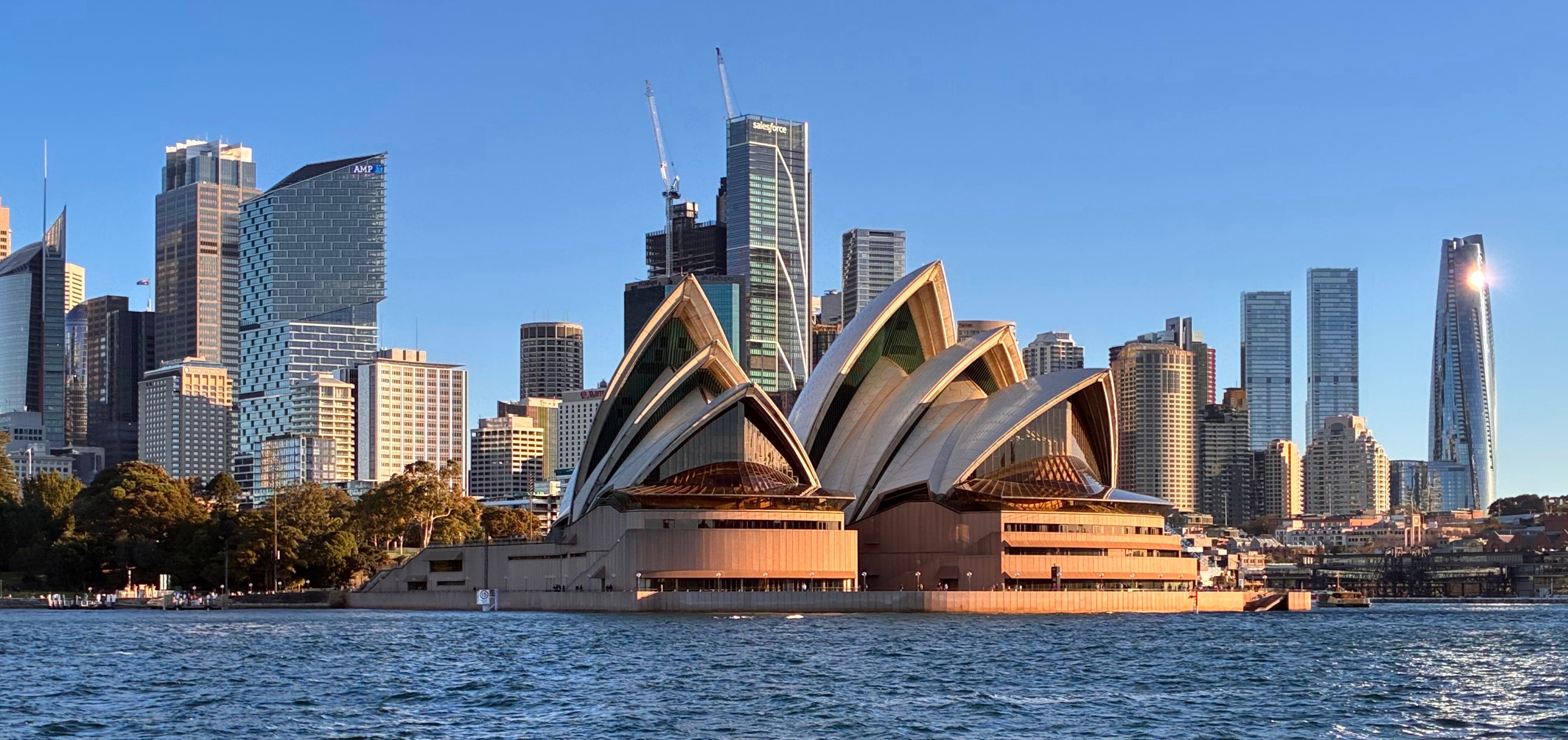
What advice would you give to a lizard sunning itself on a rock? At some point the sun will go down, but it’s hard to tell when. Would you get angry? Tell it that it needs to get up and race to find some food, some shelter, to survive the onrushing night? Or would you sympathise, and lay down beside it to enjoy the warmth of the sandstone while it lasts?
This is how I feel about Sydney. It’s a place of leisure but also commercial hustle, light without heat, a place where capital from elsewhere comes to be managed. Australia has always been a country of vast potential half-realised, and nowhere exemplifies that better than Sydney. The usual response to this is contempt. Australia just needs to Harden The F**k Up and exploit its natural resources, dismantle its bureaucracy, get serious about the China issue, unleash productivity, build nuclear power, etc, etc. But actually visiting Sydney makes it hard not to sympathise with the status quo. After all, what seems like half its population are migrants from the economic pressure cookers of east Asia; and isn’t this pluralistic ease, this abundance, the end goal of liberalism?
Even in winter I found warm, cloudless days that stretched endlessly.
Economy

The first thing you notice are the houses. Not the properties themselves, which are unremarkable, but the prices and how they find their way into every other conversation: In 2023 Sydney had among the highest price-to-income ratios on Earth at 13.8x. It was beaten only by Hong Kong at 16.7 (even San Francisco was only sitting at 9.4 thanks to its high incomes).
You can feel this in the air in central Sydney. Comedians make jokes about property investment in Chatswood. It’s in the TV commercials and the conversations you overhear in bars. Domestic short-form video is full of people arguing about tax schemes and mortgages.
But this is just a symptom of the weird structure of Australia’s economy. In many ways, Australia is more like a third-world nation than the US or China: think the resource-cursed economies of Africa. It’s just a very well-managed and functional version of the latter, ranking below Uganda in the Harvard Atlas of Economic Complexity.
Raw resources, extracted from western wastelands, account for a supermajority of goods export earnings. About half of these resources are iron ore and coal, and the customer is mainly China. So despite mining being under 15% of GDP, it warps the entire picture around it. Most of Australia’s GDP is domestic consumption and services, but the foundational funding for this system is provided by the mining exports.
The mining money is channelled into two vast capital pools: residential property and superannuation. The former is 4x GDP, the latter 1.6x, and both of those ratios are among the highest in the world. Sydney is the financial command centre where the export flows are managed and this domestic capital is allocated. The city produces around a quarter of Australia’s GDP, but it’s managing wealth flowing through from elsewhere.
Why does all the money go to houses and super? It’s a good question because this is something the government chooses; compare Australia to Norway with its sovereign wealth fund. With property, half the story is pretty simple, because it’s a typical land-trap tale. Once you create property as an attractive investment class it’s virtually impossible to back out because voters punish any defection. The interesting question is the other half - how and why did they start the cycle?
Negative gearing is straightforward in theory. Income tax is levied against all income. So if you have several sources of income, you want to sum them up to figure out the total tax bill - and if one of those sources is negative, like a money-losing investment, then your overall income and hence tax bill is lower. But it should be easy to see that this is dangerous: if you can figure out a way to accumulate wealth long-term with a bad investment, you can do that while writing off your income tax. So most countries place restrictions on these income transfers in practice. For instance, the US introduced rules in 1986 to prevent exactly this scenario of reducing income tax through losses from ‘passive activity’. During the 1980s, there was international recognition of the slippery slope this subsidy represented.
Australia saw it too, but failed to see its removal through. Around the same time (in 1985) they tried to make the same changes - restricting property loss offsets to rental income rather than wages - and introducing capital gains taxes at the same time. The CGT stuck around but immediate rent spikes in Sydney and Perth caused the government to back down on the negative gearing restrictions. This narrative, that interfering with negative gearing stultifies property investment and raises rents, has proved very durable (someone less charitable might say very convenient) despite little evidence to support it.
The stage is set and the year is 1999 - the middle of the Dotcom bubble. Neoliberal technocrats are optimistic about broad-based equity ownership creating a ‘nation of shareholders’. The trouble is that those capital gains taxes will need to be watered down to encourage productive investment. The solution is the Ralph Review of Business Taxation. Its prescription is to simplify and reduce CGT: the previous system taxed capital gains above inflation at the same rate as your income; the new one taxes half of capital gains, inflation-inclusive, at the income tax rate.
The trouble is that this new tax is asset-agnostic, but for the typical member of this ‘nation of shareholders’ leverage availability is not. Banks will lend you 90% of the price of a home but not 90% of your Pets.com investment.
But this tax change isn’t enough on its own to create the modern Sydney property market. A hugely leveraged bet on asset prices just to reduce your tax bill sounds insane in a vacuum - even if it’s positive EV, normal households don’t tend to have that kind of risk tolerance.
The trick is that the negative gearing rules mean that the government subsidises the risk. Owning a money-losing rental is fine, because the losses just mean you pay less income tax. You can hold onto it and keep putting in money, and when you sell the capital gains are taxed at half the rate of your income. And you can expect those capital gains to be positive, because this system is a near-perfect incentive structure to make the population funnel all their investment capital into the property market.
It gets even better. You might expect this demand shock to be softened by a supply response, but of course Australia has a classic Anglosphere zoning situation that holds supply fixed. The only thing that can move are prices.
Surprisingly, some of this is changing. The whole country was abuzz during my visit about a new budget that aims to finally do away with negative gearing by removing it - but only for properties bought after its passage, and not for new builds. In this case, the bias against ‘what is not seen’ is being leveraged to cut the Gordian knot of the housing situation. The only way to do it is to ensure existing interests lose nothing, but even this strategy has produced widespread backlash.
But this is unlikely to actually make a difference, despite its difficulty. The thing is that the whole complicated apparatus of negative gearing and capital gains incentives serves more as a recruitment mechanism, and actually has little effect on prices directly: completely removing it would only shift them by a few percent. It’s like blowing out a candle after it has already started a house fire. The actual driver of prices are three massive forces, one on the supply side and two on the demand side.
The supply side issue is zoning, as I’ve already mentioned. In some ways this is boring because it’s the same issue everyone is dealing with, but it’s hard to overstate the importance of it. The key here is that the tax incentives have created a huge entrenched coalition that opposes upzoning. There’s also local factors like new-build construction quality scandals and restrictive geography.
On the demand side the main factor is credit. Mortgage rates fell from 17% in 1990 to 2% in 2021. You have to remember Australia has gone three decades without a recession; the 2008 crisis never happened here. The quantity of credit available is enormous, for a variety of reasons too complex to get into here. Australian banks have slowly moved from government-enforced rationing of housing credit in the 1980s to having their books dominated by mortgages. The scary part of this is that Australia essentially only has variable rate mortgages. The entire house of cards that is Sydney is exposed to international impacts on rates on a short feedback loop.
You might have expected that COVID would have blown up this whole system. We did see glimmers of this when rising rates shaved 9% off housing prices nationwide, but the rising costs were mostly absorbed by owners’ savings and drastic cuts in consumption. The full-recourse mortgages used in Australia enable more leverage but strongly disincentivise defaults; for true housing market crashes you need distressed sellers, which don’t materialise in places like Sydney until absolute rock bottom. Finally, prices were propped up by parallel supply restrictions (building projects folding) and the other demand-side mechanism: migration.
Migration is the reason Australia has the highest population growth in the developed world. Discourse focuses on European migrants, but the Australian trend easily triples EU numbers. This partly comes down to an institutional failure; migration levels are set in Canberra but zoning is managed at the state and local level, so nobody is actually responsible for the resulting housing prices.
This all seems to make sense. So why is the superannuation pool so large if the incentives to buy property are so strong? Because the government mandates it. Employers must contribute 12% of pre-tax wages to investment accounts, which the employee can only withdraw for retirement or in special circumstances like terminal illness. It’s basically a forced saving scheme in the form of equity investments. Suppress wages but ensure younger generations don’t have to support huge cohorts of elders who didn’t save for retirement.
This seems much better than the tax-funded pensions common in the rest of the anglosphere. But there are some caveats. Australia has traditional pensions too, which many elders draw from. The flat tax rate (15%) on contributions is regressive. And there is the question of where the money is invested. Australia’s superannuation funds are enormous; they don’t just distort the domestic economy, because they are too large for it, and so a large part of Australia’s retirement savings now depends on international equity markets. This means that the Australian social contract is now exposed to subtle variations in transformer scaling laws.
There’s just so much money in this mining → property/equities pipeline that it sucks up all the talent. Even marginal tweaks at such a large scale are insanely productive, so there’s no incentive to work on anything else. You’re better off trying to get a fraction of a percent more out of billions of dollars. But that means Sydney feels very zero-sum: Australian productivity has been flat for a decade, and everyone is fighting over a piece of these enormous fixed pies. Even a little piece is enough to set you up in ease and comfort, but at the end of the day there are only so many jobs at the big firms and so many properties within commuting distance of Circular Quay.
The term ‘neo-feudal’ has been much abused, but I genuinely think it’s the best way to describe the managerial class of central Sydney. When you’re born into these families you grow up cloistered in private schools, attend university and go straight into a job (thanks to family connections) in one of the great law firms, banks, or consultancies. You stay living at home and maybe get dropped off at work by your father on his way to his partner’s carpark in a nearby building. You spend little and by your mid twenties you have a mortgage on a suburban house you rent out. Your only objective is to propagate this cycle, to leverage one mortgage into another and grow the family holdings. You live monastically and spend your weekends watching Instagram Reels about Discourse.
Infrastructure
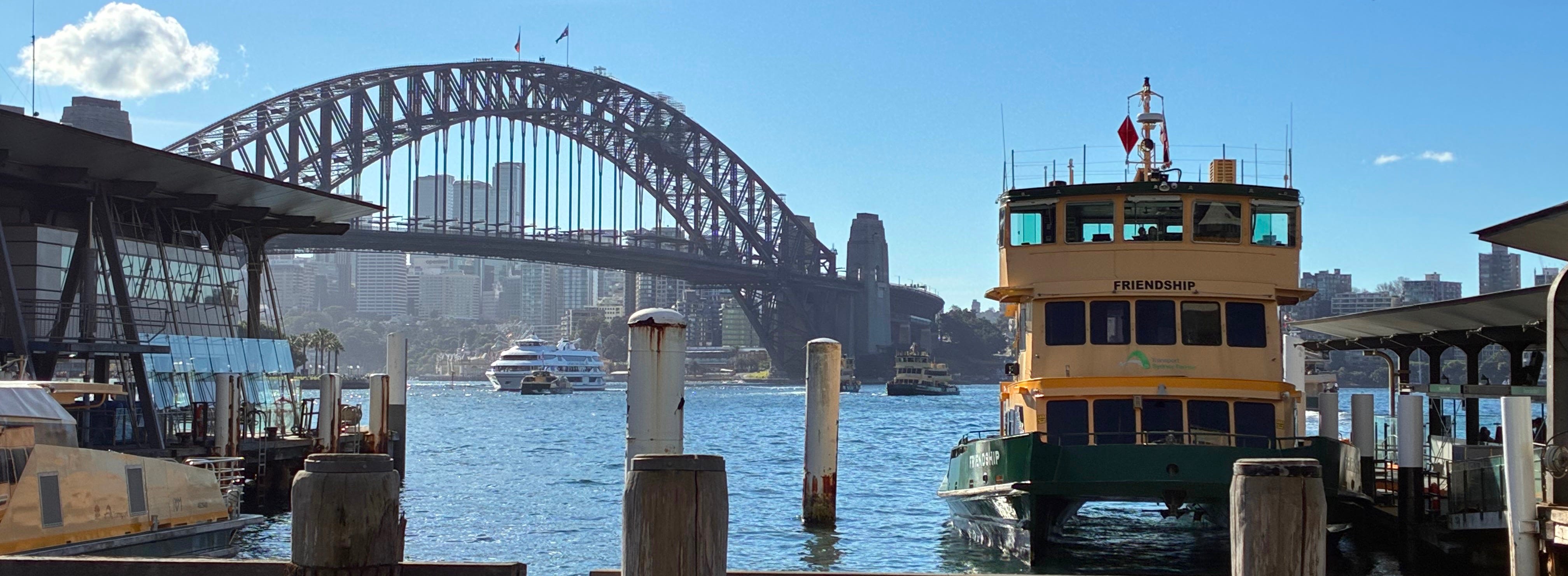
Sydney seems like a city of driving and public transport. Cycling is rarer than I expected, and walking is pleasant but time-consuming. Even the central city is laid out with expanses of parkland, wide roads, and sprawling public facilities.
There’s a lot of variance in the public transit. The bus fleet sucks. This seems weird: what’s the point of coupling your whole economy to China if you don’t even get EV buses? Procurement is underway, but the bottleneck seems like poor design of private service contracts and electrification of depots.
The double-decker workhorse trains are nice: clean, pleasant, high-capacity. And the fully automated Metro lines are a real highlight, though it’s exactly what you’d expect if you imagine 2020s Anglosphere transit architecture; a Millennial grey monument. However, these two aspects of Sydney’s urban circulatory system are locked in mortal conflict. The transit unions recognise the existential threat posed by the Metro and seem to have successfully held the city hostage; the Metro lines are automated but not unmanned.
The car fleet was not what I was expecting. Reading the news you’d expect central Sydney to be crawling in Chinese EVs, but they’re still somewhat rare - certainly more so than in Auckland. Instead Sydney is dominated by the Japanese and Koreans. Toyotas are everywhere. The typology is a mix of utes and unremarkable crossover hybrids. Sports cars are rare1 and the fleet is quite new, which makes sense for the central suburbs.
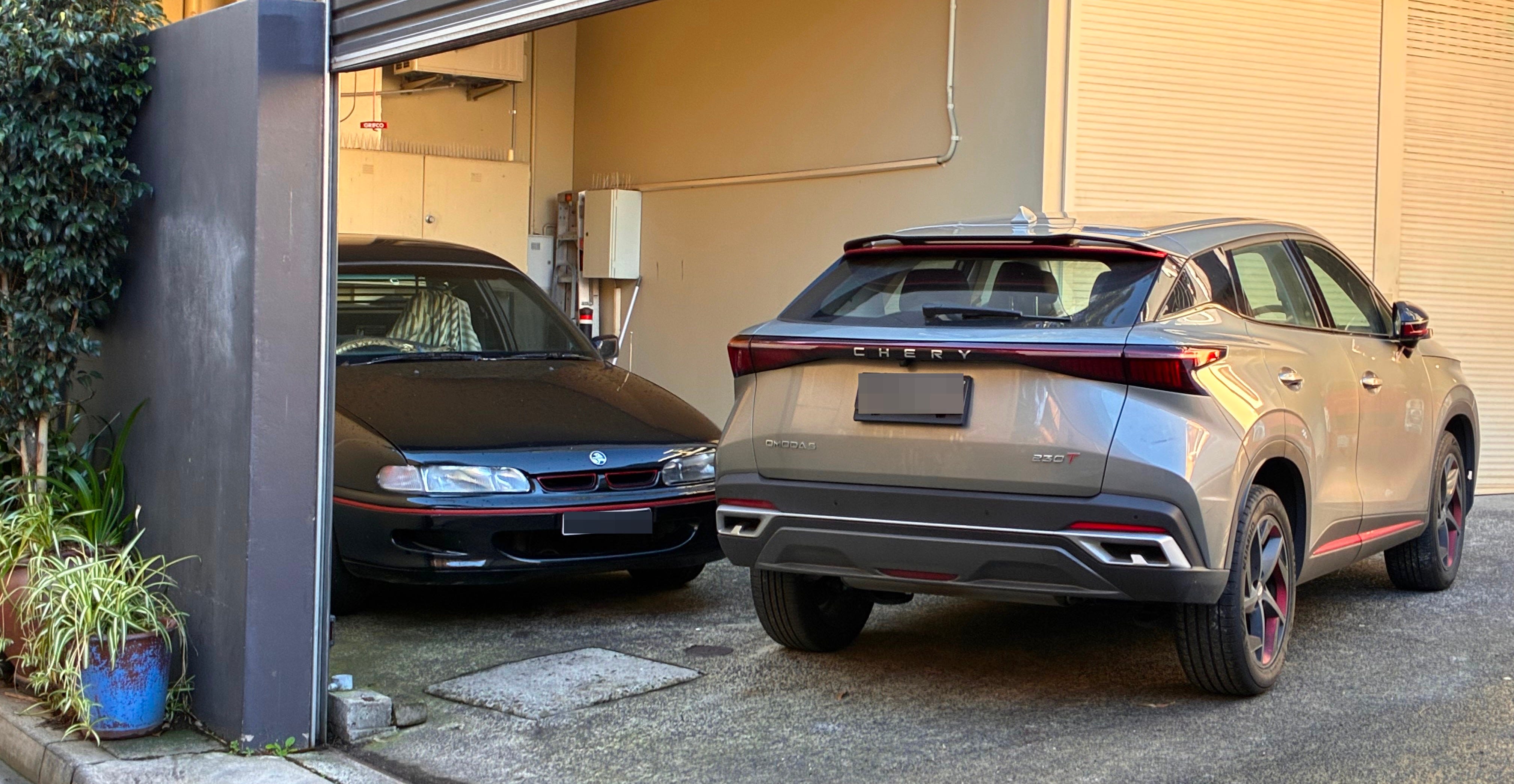
Sydney’s traffic enforcement is noteworthy. Compared to the US, there are far more speed cameras, speed enforcement is a few kph above the limit, and random breath test checkpoints are legal. Even compared to NZ (which shares most of these) it seems like there are significantly more speed cameras. And the whole city is covered in AI-powered cameras that can instantly fine you for phone use while driving. It’s good to actually enforce traffic laws, but I’m not crazy about the surveillance network. None of this seemed to have a noticeable effect on driving behaviour. One thing I did pick up on: compared to NZ, loud cars seem rarer but much louder.
Culture

I would say it’s bad to establish the norm of constant AI-powered surveillance, but you have to remember this is Australia. Urban Australians absolutely love to be managed - it feels like a national pastime, something retained from the English heritage. Consider their world-leading Covid compliance. Compliance, but not coordination; this is not management like we see in China. There is the willingness to go along with what’s passed down from above, sometimes bordering on fatalism, but no sense of coherence or willingness for sacrifice that creates the positive side of China’s outcomes.
I’ve posted before about this meme being a genuinely useful frame for thinking about the future of US culture:

This seems relevant to Sydney, one of the global wasian capitals. I visited the largest Uniqlo in the Southern hemisphere. The central city is overflowing with asian fusion and bubble tea spots; I had some of the best ramen I’ve experienced at Mensho2. Culturally, it feels right up there with Honolulu or the Bay Area. But there are subtle distinctions here: Hawaii is much more Japanese, laid-back and ultraliberal; Berkeley exemplifies the ‘judeo-Hapas’ of the image above; and Sydney feels like Confucianism with Anglo-Saxon characteristics3. Part of this comes from the geopolitical situation, where the whole economy depends on shipping raw materials to China. Overall, you get the sense that Australians would happily accept loss of control to the Politburo or Fable 8 as long as they could keep their romantasy, matcha KitKats, and blind boxes.
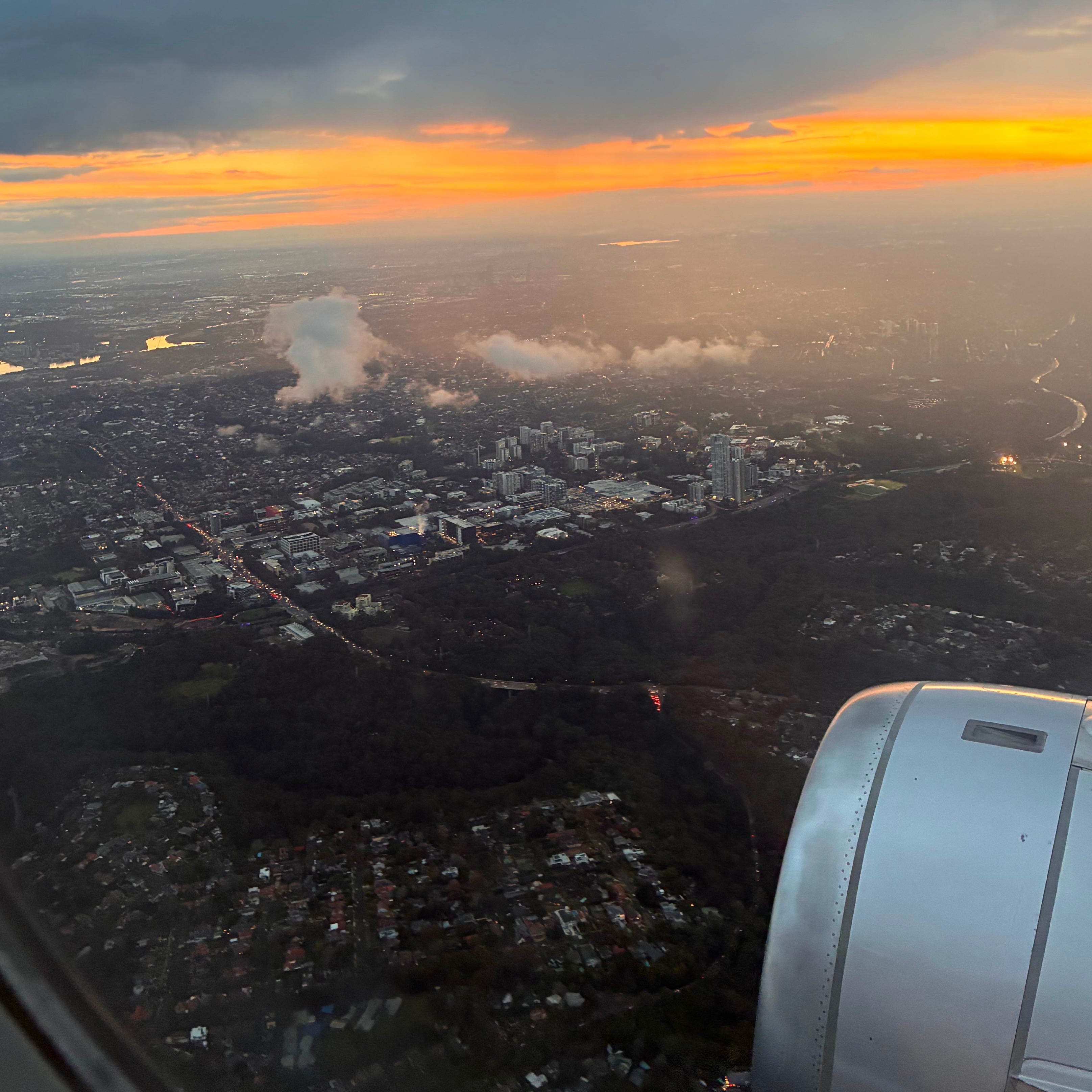
The first thing you hear upon touching down on Australian soil is a land acknowledgement. Let’s leave aside the fact that this doesn’t even make sense on the runway, which was reclaimed from a marsh, and focus on the fact that Australia is probably the global capital of land acknowledgements.
Coming from New Zealand, the relationship Australia has to its colonial past is weird. It’s very prominent. In NZ, Maori culture is common but not prominent. You have Maori coworkers and you know some words of the language but it’s just a part of life, not something you think about. In Australia you are made to think about it; your attention is called to it by other people who are not aboriginals, even though in most of Sydney you barely see any indigenous people.
Architecture


To its credit, Sydney has a design language. This is more than you can say of most cities. And it’s lovely: green4 wrought iron and tawny sandstone bricks. It’s inconsistently applied, but it pops up enough to leave an impression. The ferries, for instance, share the colour scheme.
Because Australia was colonised much earlier than New Zealand, there’s a lot more heritage buildings than I’m used to, and this really helps the central city. The Victorian style works really well in sandstone.
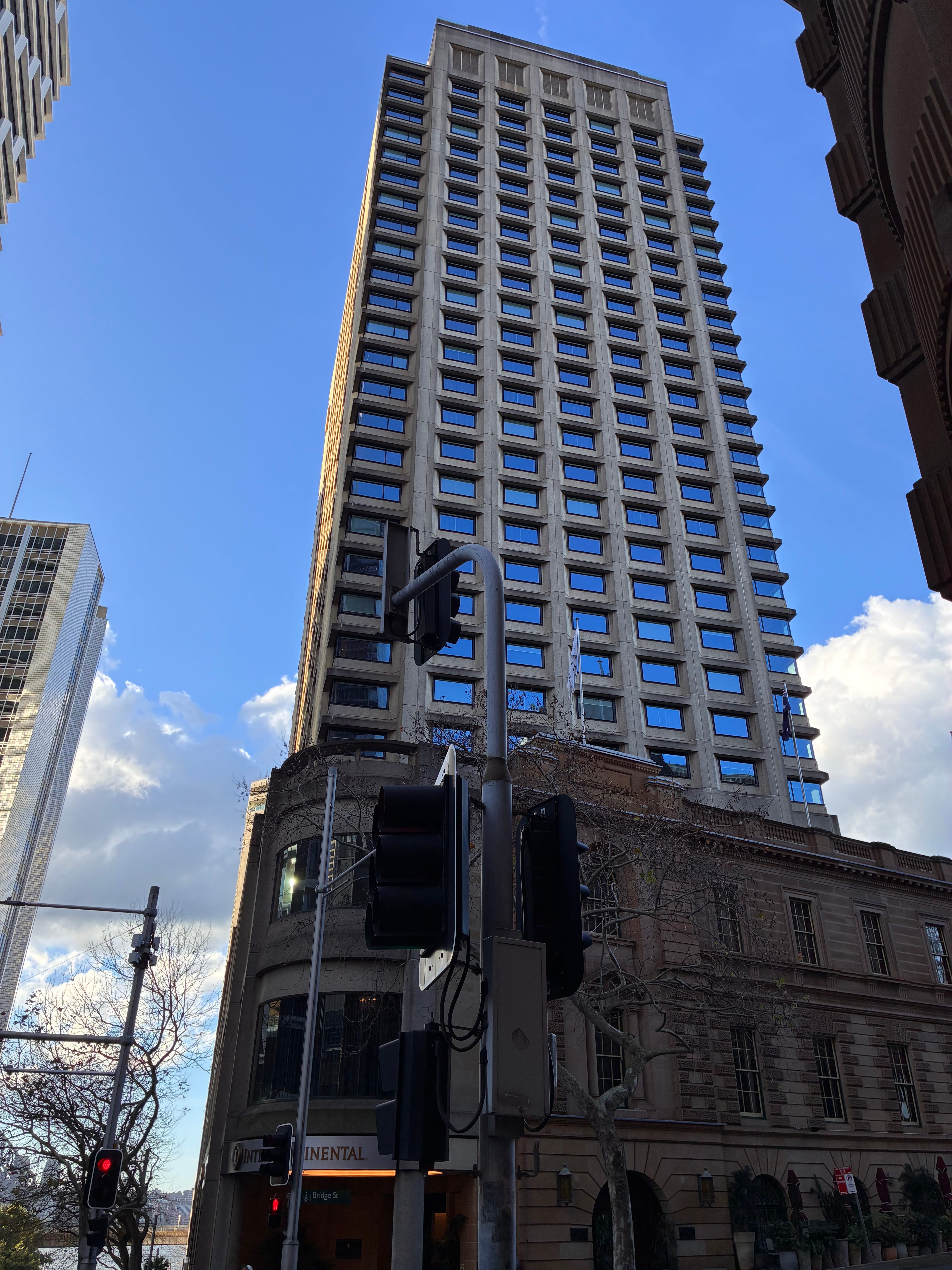
But Sydney is also a city of some distinction in the brutalism department, which was somewhat surprising. Unlike the Victorian stuff, which is uniformly wonderful (thanks partly to survivorship bias, I assume), there’s a real gamut of brutalist projects.
I found it interesting that the sandstone facades age very well, because they are masonry; compare this with the issues brutalist projects have faced with concrete weathering. Cut stone is incompatible with orthodox brutalism, which needs the uninterrupted massing and utilitarianism of poured concrete, but some buildings in Sydney like the Opera House’s base (more on this below) combine these in an interesting way. They create the same feeling I get from brutalist structures but by using sectioned tiles and masonry made of Australian stone materials, like the crushed granite used on the Opera House, that wear the decades much more gracefully.
At their best these modernist styles are sublime, but it also seems very easy to do them wrong: the ceiling and the floor are both higher. On the one hand there’s a lot of late 20th century office buildings which are truly repulsive, and the Sydney Tower would be a blight even without the huge Westfield sign - it’s decisively mogged by the Sky Tower. On the other you have some more tasteful projects… and the Opera House.
It may sound odd to mention the Opera House as a brutalist project. Obviously everyone thinks of the expressionist shells as its standout feature, but the monolithic base is remarkable in its own right and feels very brutalist. Utzon, the architect, was actually inspired by the bases of Mayan temples here. Many aspects of the Opera House are like this: it looks back to the colonnades of Greek amphitheatres and the wide steps of Chinese temples. But many of these features also feel like they share DNA with the better brutalist buildings in central Sydney. It looks forward and backward at the same time, picking and choosing the best of what has survived the test of time while also daring to leap ahead with something radically new. I feel a lot of kinship with it ideologically.
It’s also brutalist in that it feels like a utopian project, like an arcology. Not a watered-down hive city, but a true arcology as Soleri imagined them. The whole building juts into the harbor like a ship about to cast off its moorings. The lower reaches have sunken colonnades with restaurants set into their walls; great decks stretch out from the upper floors at ground level, creating concourses. It all feels ergonomic - even more so than the European capitals beloved by urbanists, which are beautiful and convenient but not conceived as a single structure. The Opera House is a great place to spend time, not just a venue.


You can just imagine the ribs inside the sails as fins of an enormous heatsink, perhaps radiating entropy from the Mind housed in the base below.
These elements - modernism, Victorian facades, and the local materials - combine to form something promising. It feels like there’s a synthesis waiting to be made here. If I had to come up with some way out of our current architectural stagnation, Sydney would be where I’d start.
The way forward
It feels as though there are three futures for Sydney.
Firstly, might Sydney represent a good strategy? If we live in a world where AI really is about to progressively take over the entire economy, those who come out best might be cultures which are ready to accept loss of control, which excel at leisure, and which are focused on refined consumption. Sydney’s focus on rivalrous goods like housing is similar. Think of the pundits recommending people buy waterfront real estate in Africa as a hedge against AGI. Might the property-obsessed Sydneysiders have the last laugh?
At the same time, this squabbling over a fixed pie seems like a clear way to end up left behind, degenerating along the same trajectory as the UK. Even in a much wealthier world like post-Singularity ones it could lead to a dystopia as material abundance merely adds fuel to the fire. Sydney’s society, funded by the distant mines, is in some ways a peek behind the curtain of what post-scarcity might look like without cultural innovations; I find aspects of that vision horrifying.
But I think the most likely outcome is that Sydney is passed by. Some reforms will be made, but not the deep structural changes that are required for true revitalisation. Australia will remain an economic vassal of Chinese demand and American capital markets; independent elements of the country outside these verticals will continue to wither away. This is a local maximum in the medium term, but the long-term prospects seem grim. In all likelihood, any chance of AGI riding in to keep the consumption train running is still a long way off.
It is true that there are powerful selection effects at work here. Not everywhere has to be San Francisco or London’s financial district. Those who want that world can move to those places; there is no shortage of demand for what Sydney offers. And, as I said in the introduction, it’s hard to resent people for that set of preferences.
I think it’s a mistake to reject liberalism entirely like various vanguards of the modern right, but liberalism’s limitations are on display most clearly in places like Sydney. Rawls was encyclopaedic on redistribution across space, but redistribution across time (in the form of his just savings principle) got a much more cursory treatment. When you have a society like Australia that drifts into the doldrums of - for instance - Dutch disease, liberalism’s otherwise-admirable commitment to stay out of prescriptive visions of the good can keep things held in stasis. I think this goes all the way back to Tocqueville and the dissolution of the intermediary layers of pre-liberal societies. In many ways this was a good thing. These layers were coercive institutions that oversaw horrors. But they also acted as machinery for solving coordination problems, for enabling collective sacrifice, in a way modern Australia is unable to even against existential threats. There are so many projects that poll well and seem obvious, from the Fix Everything Easily Switch of housing reforms to stepping up as a regional Pacific power, that nevertheless cannot get off the ground.
It feels like Sydney has arrived at a paradox. It cannot shift into a new and better paradigm without something completely new or institutions it has already abandoned. But in the meantime, the rocks are warm and the days are long.
I’m starting to realise how much my perspective on this is skewed by NZ having among the highest rates of per-capita sports car ownership in the world.
I am a tasteless hick when it comes to food, so take this with a grain of salt.
Southeast Asian influences are also much stronger.
The specific colour, Brunswick Green, is wonderful and apparently has a lot of history as a British standard behind it.
This was brilliant, and as an Aussie (though born in NZ) living overseas I’m convinced that Australia can only be comprehended properly by looking in from the outside. On my yearly trip back home when talking to friends it’s remarkable how quickly every single conversation degrades into being about the property market. We were raised with some of the most extraordinary circumstances on earth: this energy is redirected into working for multinationals, chasing a bigger bonus, buying the third investment property. Thanks for this, I learned a lot!